
 By Shishir Prashant
PrashantNews
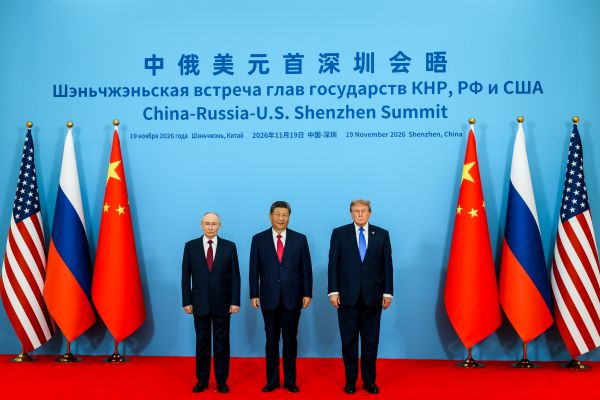
The first-ever trilateral summit bringing together US President Donald Trump, Russian President Vladimir Putin and Chinese President Xi Jinping may have made diplomatic history, but it ended without any major breakthrough on the conflicts and strategic differences that dominate international politics.
After an approximately 80-minute meeting in the Chinese city of Shenzhen, the three leaders issued a joint declaration on peace, committing themselves to reducing nuclear risks, preventing nuclear proliferation, reforming the United Nations and ensuring stable energy supplies. They also called for greater protection of immunity for state officials from international court proceedings.
However, the declaration made no mention of the wars in Ukraine and Iran, two of the most pressing issues that Trump had hoped to address. Nor did the leaders announce any concrete agreement on nuclear disarmament, despite the expiry of the last major US-Russia nuclear arms control treaty earlier this year.
Yet, the summit was not without significance. Each leader appeared to have secured something from the unprecedented diplomatic gathering.
For Trump, the meeting offered an opportunity to reinforce his image as a global dealmaker capable of bringing together leaders of two countries that Washington considers its principal strategic competitors. His emphasis on personal relationships and direct engagement with Xi and Putin was central to the summit’s messaging. However, he returned without a demonstrable agreement to end either the Ukraine or Iran conflict.
For Putin, the summit was arguably an important diplomatic opportunity. With Russia facing Western sanctions and international criticism over its invasion of Ukraine, sitting alongside the American and Chinese presidents at a high-profile international gathering offered the Russian leader considerable diplomatic visibility. It also provided him an opportunity to press Moscow’s position on Ukraine directly before Trump.
For Xi, hosting the historic gathering reinforced China’s growing ambitions to position itself as a major centre of international diplomacy. By bringing Washington and Moscow to the same negotiating table, the Chinese president demonstrated Beijing’s ability to convene the world’s two other leading nuclear powers. His emphasis on avoiding Cold War thinking and maintaining communication between major powers also fitted China’s broader diplomatic narrative.
Xi Jinping later said that the China-Russia-U.S. summit has been positive, constructive and fruitful. Xi made the remarks while summarizing main consensus reached at the summit.
The declaration’s position on the International Criminal Court was another notable outcome. The three countries called for respect for state sovereignty and immunity for government officials, a particularly important issue for Putin, who faces an ICC arrest warrant over alleged war crimes in Ukraine.
The summit also raised concerns among American allies in Europe and Asia about the possibility of major powers discussing international security arrangements without adequately considering the interests of smaller countries.
Ultimately, the Shenzhen meeting demonstrated that the three leaders are willing to engage despite their deep differences. But willingness to talk is not the same as willingness to compromise.
The real test of this historic gathering will be whether its declaration translates into concrete diplomatic initiatives on Ukraine, Iran, nuclear arms control and global security. For now, the leaders have achieved diplomatic visibility and a commitment to continued dialogue, rather than a settlement of the world’s most pressing problems.