
 By Shishir Prashant
PrashantNews
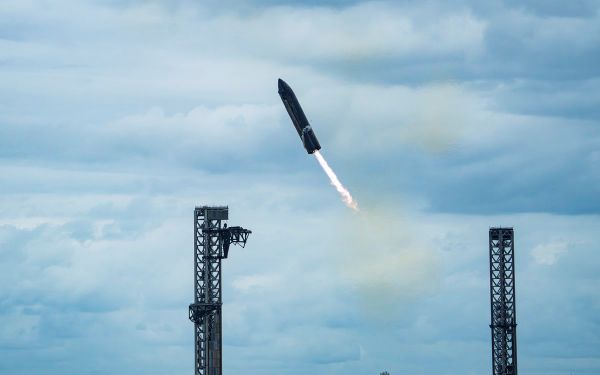
SpaceX has achieved a remarkable feat in space technology by bringing its giant Starship spacecraft back from space and catching it in mid-air with the help of two mechanical arms fitted to its launch tower in Texas in the US.
The manoeuvre is significant because, instead of landing on the ground, the spacecraft returned to the same launch site and was held in the air by the tower’s giant arms, popularly known as ‘chopsticks’.
But how does this technology work?
The Starship rocket system consists of two sections. The lower part, called the Super Heavy booster, provides the thrust needed to lift the spacecraft into space. The upper section, Starship, carries cargo, satellites and eventually astronauts.
After the two sections separate, Starship continues its journey while the booster returns towards Earth.
During its return, Starship first passes through the Earth’s atmosphere, where friction generates intense heat. Special heat-resistant tiles protect its outer body from burning. It then uses its aerodynamic surfaces and engines to slow down and control its descent.
As it approaches the launch tower, onboard computers guide the spacecraft towards a precise position. Its engines help it manoeuvre into an upright position just above the tower.
This is where the most interesting part begins.
The launch tower, nicknamed ‘Mechazilla’, has two giant mechanical arms that remain open as the spacecraft approaches. At the right moment, these arms close around specially designed catching points on the spacecraft’s body and hold it suspended above the ground.
In simple terms, imagine catching a falling pencil between two fingers. SpaceX has demonstrated the same principle, but with a massive spacecraft weighing several tonnes and returning at high speed.
The technique eliminates the need for conventional landing legs and could make it possible to bring the spacecraft back, inspect it, refuel it and prepare it for another flight.
The larger objective is to make rockets reusable rather than discard them after every mission, thereby reducing the cost of space travel.
SpaceX is developing Starship for future missions to the Moon and Mars. The successful mid-air capture represents an important step towards making such ambitious space missions more economical.