
 By Shishir Prashant
PrashantNews
India is advancing a range of emerging space technologies, including reusable launch vehicles, electric and green propulsion, autonomous spacecraft docking and advanced Earth observation systems, as it seeks to strengthen self-reliance and expand its space economy to $44 billion by 2033.
According to the Department of Space, these technologies are expected to support future human spaceflight missions, the proposed Bharatiya Antariksh Station, lunar exploration and commercial satellite launches, while reducing dependence on foreign technology.
India’s space programme began with the launch of its first sounding rocket from Thumba in Kerala on November 21, 1963. The Indian Space Research Organisation (ISRO), established in 1969, has since developed launch vehicles and satellite systems serving communication, weather forecasting, agriculture, disaster management and national security.
A major step towards expanding launch capacity came in September 2024, when the Union Cabinet approved the development of the Next Generation Launch Vehicle (NGLV) at a cost of ₹8,240 crore. Designed to carry up to 30 tonnes to low Earth orbit, the vehicle is expected to triple the payload capacity of India’s existing LVM3 rocket. A partially reusable variant is also being developed to reduce launch costs.
ISRO has separately demonstrated autonomous runway-landing technologies through its winged Reusable Launch Vehicle demonstrator, Pushpak. The experiments are intended to develop technologies needed to recover and reuse launch vehicle components.
India has also made progress in spacecraft operations. Through the Space Docking Experiment (SpaDeX), ISRO demonstrated autonomous docking of two satellites in January 2025, followed by further docking and bidirectional power-transfer demonstrations in April. The achievement made India the fourth country to demonstrate space docking, an essential capability for future space stations and complex missions.
In propulsion technology, ISRO is developing indigenous electric thrusters and alternative, environmentally friendlier propellants. It is also exploring radioisotope-based heating and power systems for possible future planetary missions.
Advanced satellite technologies are another priority. The NASA-ISRO Synthetic Aperture Radar (NISAR) satellite, launched in July 2025, uses two radar frequencies to monitor changes in the Earth’s surface, supporting research on glaciers, vegetation, ground movement and natural hazards. India’s NavIC navigation system and high-throughput communication satellites are also strengthening civilian and strategic capabilities.
The government is seeking greater private-sector participation in the space industry. The Department of Space said the state-run NewSpace India Limited had signed 118 technology-transfer agreements covering 83 ISRO-developed technologies. Investment in Indian space start-ups reached approximately $618.5 million by March 31, 2026.
The developments are expected to strengthen India’s technological independence while creating opportunities for domestic companies in the expanding global space market.
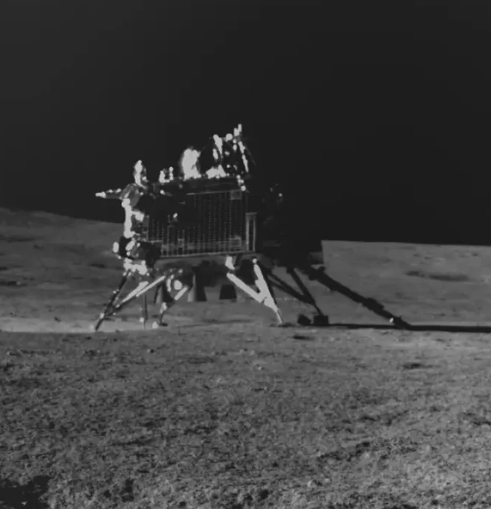
Caption: The Chandrayaan-3 lander on the surface of the Moon, imaged by the rover Pragyan from 15 meters away