 By Shishir Prashant
PrashantNews
Bringing together intellectual perspectives of Tagore and Ambedkar in the context of Anthropology, Sociology, Literature and Social Justice, academicians at a colloquium on Thursday explored the intersections of universal humanism, social inequalities, cultural traditions and constitutional justice, with particular attention to the Central-Western Himalayas.
These deliberations were made at a one-day Inter-Chair Collaborative Colloquium titled “Tagore and Ambedkar and the Unfragmented World: Literature, Himalayan Anthropology and Social Justice” at Doon University jointly organised by the Dr. B. R. Ambedkar Chairs of Doon University and the University of Calcutta.
Academicians highlighted the continuing relevance of Rabindranath Tagore’s ethical universalism and Dr. B. R. Ambedkar’s vision of social justice in understanding contemporary social structures and cultural practices. Through discussions on literary representations, indigenous belief systems, Himalayan sacred geographies and exclusionary practices, the colloquium examined how diverse knowledge traditions can contribute to a more inclusive and socially just world.
Approximately 200 participants, including faculty members Dr Richa Joshi, Dr Gajala, Dr Aditi Bisht, Dr Ashutosh Pande, Ms Divyanjali Bijalwan and researchers from Doon University and the University of Calcutta, participated in the academic deliberations.
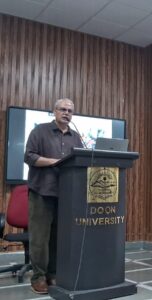
Delivering the keynote address on “Rabindranath Tagore and the Anthropological Imagination: Universal Humanism, Visva-Bharati, and Nationalism,” Prof. Subrata Sankar Bagchi, Dr. B. R. Ambedkar Chair Professor at the University of Calcutta, presented Tagore’s social philosophy as a critique of narrow nationalism, cultural hierarchy and the fragmentation of human relationships.
Prof. Bagchi emphasised that Tagore’s conception of manush—the human being realised through relationships with others and with nature—offers a framework for understanding human dignity beyond rigid cultural and national boundaries. He explained that Tagore’s universalism was not merely an abstract philosophical ideal but an ethical position that enabled him to challenge European imperialism and racial discrimination while also criticising social inequalities within Indian society.
Building on the keynote’s discussion of universal humanism, Dr. Lokesh Ohri, anthropologist and author, spoke on “Tagore’s Unfragmented Worldview in the Context of the Central-Western Himalayas.” He examined the relationship between Tagore’s critique of social exclusion, historical anti-caste movements in Bengal and the lived realities of caste and religious traditions in Uttarakhand.
Dr. Ohri discussed Tagore’s literary engagement with untouchability, purity and pollution, and social inequality, particularly in works such as Gora and Chandalika. He also outlined the historical limitations of Tagore’s reformist framework in relation to Ambedkar’s demand for independent political safeguards and representation for the Depressed Classes during the debates surrounding the 1932 Communal Award.
Turning to the Himalayan region, Dr. Ohri explored the ritual polity associated with the Mahasu deities and the relationship between traditional systems of authority and the modern state. He examined the cultural significance of the processions of the Mahasu brothers—Bautha, Pabasi, Bashik and Chalda—and their role in sustaining collective memory, inter-village relationships and shared cultural identities.

Dr. K. R. Nautiyal, anthropologist and former Additional Director General of the Indian Coast Guard, presented a paper titled “The Sacred Universe of the Jaunsari: An Anthropological Perspective on Faith, Ritual and Tradition.” He argued that Jaunsari religious traditions should be understood as an interconnected system of beliefs, rituals, social obligations and relationships between human beings and nature, rather than as isolated practices of worship.
Dr. Nautiyal explained how cultural traditions can be analysed through historical context, symbolic meanings, social functions and ritual practices. He cautioned against early evolutionary theories that ranked societies according to a presumed progression from primitive belief systems to modern scientific thought.
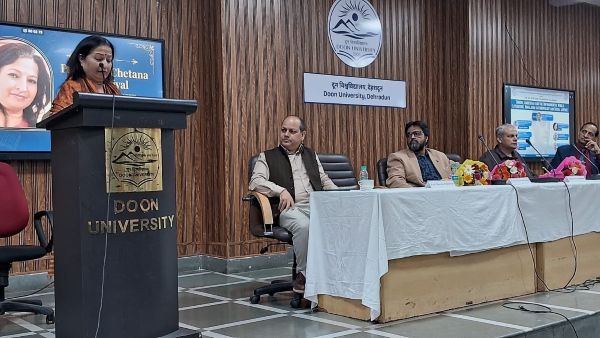
Prof. Harsh Pati Dobhal, Dr. B. R. Ambedkar Chair Professor at Doon University, moderated the academic proceedings and facilitated the exchange of ideas across the colloquium’s thematic areas. The deliberations under his moderation brought literary, philosophical and anthropological perspectives into conversation, connecting Tagore’s universal humanism and Ambedkar’s commitment to social justice with questions of caste, cultural identity and social transformation in the Himalayan region.
Prof. Chetana Pokhriyal, Dean of the School of Languages at Doon University, offered the concluding remarks, synthesising the central themes of the colloquium. She highlighted the importance of bringing literature, anthropology and social thought into dialogue to understand the relationship between universal human values and the specific historical and cultural contexts in which communities live.
The discussions reaffirmed the relevance of examining Himalayan cultural practices alongside questions of equality, dignity and social justice. The exchange between Tagore’s vision of an interconnected humanity and Ambedkar’s insistence on structural and constitutional remedies for caste inequality emerged as a significant framework for further interdisciplinary research.
The colloquium, organised in collaboration with the university’s Departments of Anthropology and English, commenced with a formal welcome by Dr. Manwendra Bartwal and concluded with a vote of thanks by Dr Saumyata Pande.