 By Shishir Prashant
Experts Deliberate on Dr. B.R. Ambedkar’s Vision for Indian Agriculture, Land Reforms, and Sustainable Rural Development
PrashantNews
Prominent academicians, agriculture scientists, researchers and social policy experts have emphasised that modern agricultural challenges require deep conceptual frameworks that blend economic viability with social equity to achieve true rural transformation.
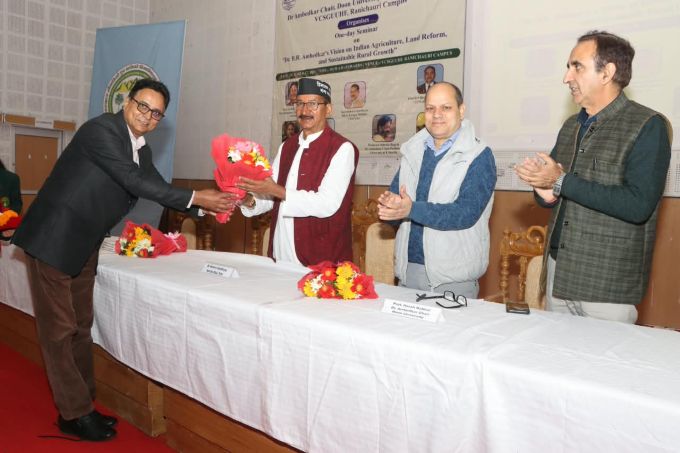
Addressing these dynamics in a seminar on “Dr. B.R. Ambedkar’s vision for Indian agriculture, land reforms, and sustainable rural development” organised by Doon University’s Dr Ambedkar Chair and VCSG Uttarakhand University of Horticulture and Forestry, they elaborated on how Dr. B.R. Ambedkar’s vision for Indian agriculture could address some critical aspects of structural crises in India’s primary sector.
The experts emphasized that tackling contemporary agrarian issues demands a radical departure from purely technical solutions, advocating instead for a comprehensive restructuring of land ownership, institutional credit systems, and resource distribution to uplift marginalized communities.
Delivering the keynote address of the seminar, Prof. Subrata Sankar Bagchi, Dr. B. R. Ambedkar Chair at the University of Calcutta, provided a rigorous academic dissection of Dr. Ambedkar’s economic treatises, focusing specifically on his landmark 1918 research paper regarding small holdings in India and their remedies. Prof. Bagchi clarified that Dr. Ambedkar did not believe the sub-division and fragmentation of land holdings was merely a problem of size, but rather a problem of a disproportionate mix of productive factors—specifically, an excess of labor relative to available capital and land. He explained that Dr. Ambedkar’s insistence on industrialization was a strategic prerequisite to relieve the crushing burden of population pressure on land, thereby allowing agriculture to become an efficient, profitable, and surplus-generating sector.
Welcoming the distinguished gathering at the commencement of the program, Prof. S. P. Sati, Registrar of VCSG UUHF, delivered the inaugural and welcome address, highlighting the profound importance of academic engagement with the ideas of Dr. B. R. Ambedkar. Prof. Sati noted that while Dr. Ambedkar is globally revered as the chief architect of the Indian Constitution, his groundbreaking contributions as an institutional economist remain vital for resolving modern crises in agriculture, social justice, inclusive development, and rural transformation.
In an attempt to bridge the gap between academic theory and grassroots political execution, Kishore Upadhyay, Tehri MLA and former minister, argued that sustainable rural development in the modern era requires a dual approach of empowering smallholder farmers through state-backed infrastructure and dismantling institutional barriers. Reflecting on the specific challenges of Uttarakhand, Dr. Upadhyay noted that out-migration, fragile hill ecologies, and highly scattered land holdings threaten food security and rural livelihoods. He urged the academic and scientific community to draw inspiration from Dr. Ambedkar’s visionary economic frameworks to formulate decentralized, community-driven policies that can transform the agrarian economy of the hill regions.
Prof. Harsh Dobhal, Dr. B. R. Ambedkar Chair at Doon University, focused his deliberations intensely on Dr. Ambedkar’s systemic contributions to social justice, economic equality, and the comprehensive empowerment of marginalized communities. Prof. Dobhal emphasized that Dr. Ambedkar analysed agriculture through the lens of political economy and sociological structures rather than treating it purely as a technical or commercial enterprise. He elaborated on the land-caste nexus, showing how rural livelihoods in India are inextricably linked to social hierarchies where land ownership acts as a primary vehicle for social status and economic dominance, often trapping marginalized groups in cycles of landlessness.
Dr. Pankaj Lal of VCSG UUHF discussed the relevance of Dr. Ambedkar’s ideas to contemporary agricultural and rural development concerns. He highlighted the importance of equitable resource distribution, institutional support and inclusive policies for improving the socio-economic conditions of rural communities.
Dr. Sachin Kumar focused on the need to integrate social equity with agricultural development. He emphasised the role of education, awareness and appropriate development interventions in addressing rural inequalities and improving livelihood opportunities.
Dr. Ankit Tamta highlighted the importance of sustainable rural development and the relevance of Ambedkar’s principles in addressing emerging challenges. He stressed the need for inclusive approaches that recognise the needs of disadvantaged communities and promote equitable access to opportunities and resources.
Prof. Amol Vasisth, Associate Director Research, summarized the proceedings and delivered the valedictory address and vote of thanks. He acknowledged the contributions of the distinguished speakers, university officials, faculty members, researchers, students and organising teams in making the programme successful. He reiterated the importance of continuing academic dialogue on Dr. Ambedkar’s ideas and their application to contemporary developmental challenges.
The programme was moderated by Dr. Atul Kumar, who coordinated the proceedings and facilitated the sessions. Dr. Pankaj Thakur and Dr. Vaishnavi Uniyal served as rapporteurs, documenting the major discussions and key observations of the seminar. Dr. Vipin Kumar coordinated the technical aspects of the programme.
Other speakers and research scholars from various parts of the country subsequently presented specialized papers during the technical sessions addressing contemporary agricultural crises by applying Dr. Ambedkar’s principles to issues such as climate change adaptation in hill agriculture, digital land records for transparent governance, and the rising feminization of agrarian labour. They collectively argued that achieving sustainable development goals requires evaluating agricultural schemes through a framework of social justice, ensuring that women and marginalized peasants receive equal credit access and secure land titles.
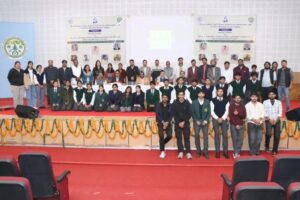
The seminar, which brought together Dr. B. R. Ambedkar Chairs from Doon University and University of Calcutta, faculty members, researchers, and students, was attended by over 200 participants.