
 By Shishir Prashant
PrashantNews
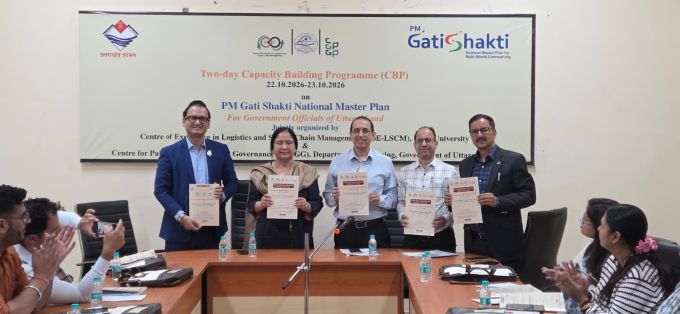
A two-day workshop commenced at Doon University to strengthen the logistics skills of Uttarakhand government officials and employees and enhance their ability to use Geographic Information System (GIS) tools on the PM Gati Shakti National Master Plan portal. Organised on 22–23 October 2026, the programme forms part of the continuing capacity-building workshop series jointly conducted by CPPGG and the university’s CoE-LSCM.
The workshop is being organised by the Centre for Public Policy and Good Governance (CPPGG), under the Planning Department, Government of Uttarakhand, and the Centre of Excellence in Logistics and Supply Chain Management (CoE-LSCM), Doon University. The series aims to equip government personnel with practical knowledge of logistics, supply chain management and geospatial technologies for application in departmental planning and infrastructure projects.
In her welcome address, Doon University Vice-Chancellor Prof. Surekha Dangwal emphasised the importance of collaboration between universities and government institutions in advancing capacity building, research and sustainable development. She observed that combining academic expertise with administrative experience can help develop better plans aligned with local needs. She also highlighted the importance of connecting young people’s energy, creativity and research capabilities with development priorities.
During the inaugural ceremony, Doon University and CPPGG signed a Memorandum of Understanding (MoU) to establish an SDG Youth Engagement Centre at the university. The centre will engage young people in research, innovation, awareness and community participation related to the Sustainable Development Goals (SDGs), encouraging their involvement in addressing local development challenges.
Dr. Manoj Pant, Additional Chief Executive Officer, CPPGG, presented the programme’s strategic framework and highlighted the need for technology-enabled governance and interdepartmental coordination. He outlined the role of CoE-LSCM, with support from SETU and the Planning Department, and emphasised the importance of strengthening government personnel’s technical capabilities for integrated infrastructure planning.
The two-day workshop provides participants with practical exposure to the PM Gati Shakti National Master Plan portal, interpretation of GIS-based maps, integration of geospatial data layers and spatial analysis. The training aims to strengthen their ability to identify connectivity gaps, assess project locations and priorities, and improve coordination across departmental plans using available data.
Developing logistics skills is a central component of the programme. Logistics and supply chain management encompass the collection, storage, transportation and timely delivery of goods from production areas to end consumers, the said the training programme adding effective management requires roads, collection centres, warehouses, processing units, cold chains and markets to be considered as an interconnected system. GIS helps analyse the geographical distribution of these facilities and their connectivity, while the PM Gati Shakti portal provides a common platform for integrated infrastructure planning,” it said.
This approach is particularly relevant to Uttarakhand’s mountainous terrain. Improving market access for dairy farmers, fruit and vegetable growers, artisans and local enterprises requires consideration of travel time, route availability, seasonal disruptions and storage facilities alongside distance. For example, coordinating milk collection routes with chilling centres can help preserve product quality. Similarly, integrated planning of collection, storage and transportation facilities can help reduce agricultural produce losses and support timely access to markets.
The broader objective of the CPPGG–CoE-LSCM workshop series is to embed these practical skills in government planning processes. Participants will be better equipped to assess departmental projects in relation to wider transport networks, local economic activities and citizens’ needs, supporting more coordinated and evidence-based planning.
The PM Gati Shakti National Master Plan completed five years on 13 October 2026. Launched on 13 October 2021, the initiative promotes coordination among ministries and departments, multimodal connectivity and integrated infrastructure planning. Skilled government personnel and the effective use of geospatial technologies are important to translating these objectives into practice.
Prof. H. C. Purohit, Dean of Students’ Welfare and IQAC Coordinator, described the collaboration between the university and the government as an important step towards strengthening research, skill development and the local economy. He highlighted the role of efficient logistics and effective supply chain management in enhancing the competitiveness of Uttarakhand’s agricultural products, dairy sector, handicrafts and local enterprises. He also emphasised encouraging students, through the SDG Youth Engagement Centre, to investigate local challenges and work with communities to develop practical solutions.
The proposed SDG Youth Engagement Centre will promote interdisciplinary research, youth-led initiatives and the integration of the Sustainable Development Goals into academic curricula and institutional activities. It will provide students with opportunities to understand local development challenges and participate in community-based initiatives.
The ceremony was attended by Mr. Durgesh Dimri, Registrar, Doon University; Prof. Bhupendra Singh Bisht, Head of the Department of Geography; and Prof. Sudhanshu Joshi, Coordinator, CoE-LSCM. The third edition of the programme proceedings was released on the occasion, and a memento was presented to Vice-Chancellor Prof. Surekha Dangwal.
Other attendees included Dr. Naresh Chandra, Assistant Director and Nodal Officer for PM Gati Shakti; Dr. Ajay Kukshal; and PMU team members Aishwarya Avneesh, Navraj Chhetri, Akshay Jaiswal, Kailash Rawat and Jagriti Tiwari. Tanuja Joshi, along with other university faculty members and participants, was also present.
The inaugural ceremony concluded with a vote of thanks delivered by Dr. Sudhanshu Joshi, Coordinator, CoE-LSCM. He expressed gratitude to the distinguished guests, government officials and employees, faculty members, organising team and institutional partners for their contributions.