
 By Shishir Prashant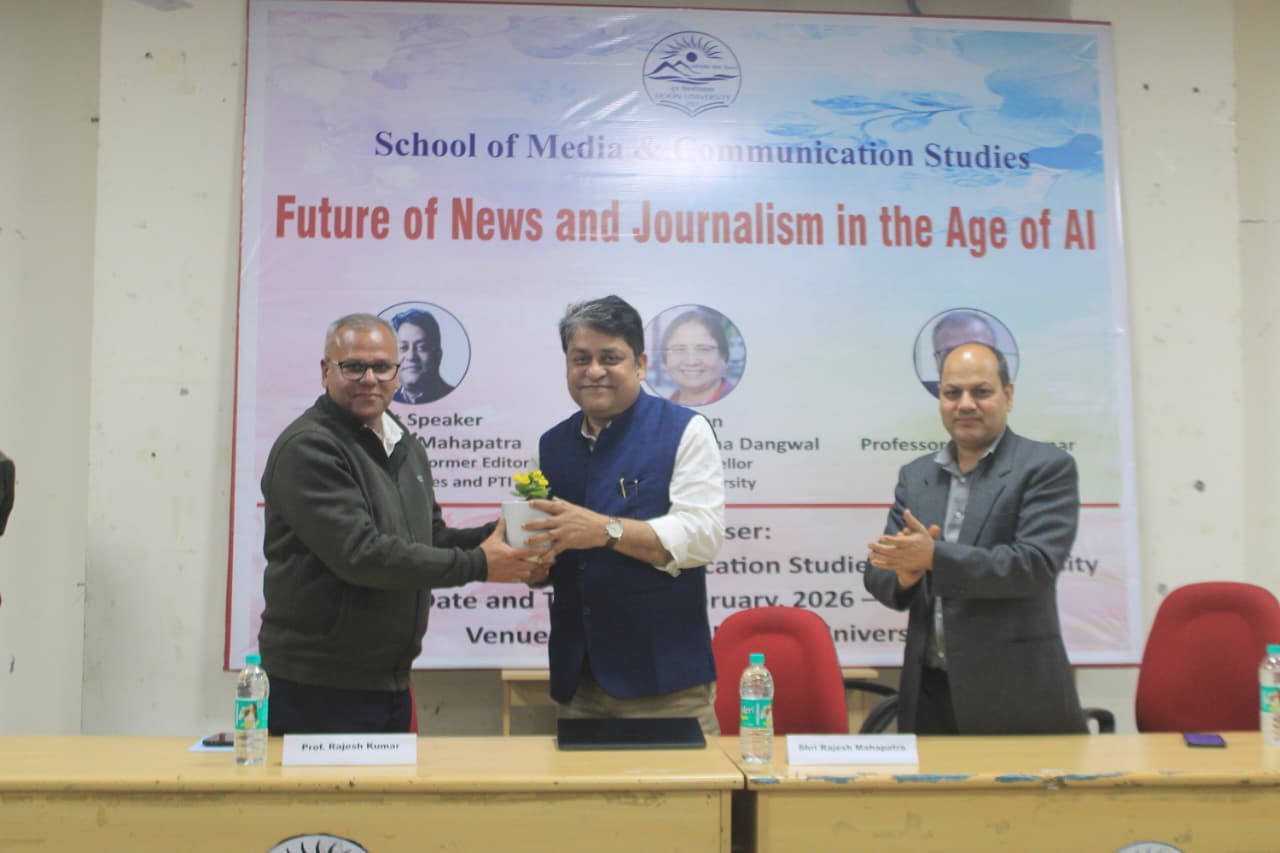
PrashantNews
The global news industry is undergoing a structural shift where Artificial Intelligence (AI) is moving from a futuristic concept to a daily newsroom reality, requiring journalists—particularly those in production and desk roles—to urgently update their skills or face the very real risk of professional displacement, a top journalist has said.
Rajesh Mahapatra, a veteran journalist and former Editor of Hindustan Times and PTI, emphasized that the innovative use of AI has become the ‘need of the hour’ for media professionals to remain relevant.
Mahapatra was speaking at the School of Media and Communication Studies at Doon University which recently hosted a critically relevant special lecture titled “The Future of News and Journalism in the Age of AI.”
The lecture delved into the specific areas where AI is already reshaping the profession, particularly through automated content generation for data-heavy reporting such as financial earnings and sports scores. Mahapatra pointed out that for journalists, AI serves as a powerful ‘multiplier of efficiency,’ capable of generating reader-friendly headlines and providing a final professional polish. However, he drew a sharp distinction between automated tasks and the irreplaceable nature of high-stakes reporting. Mahapatra asserted that while AI can sort through millions of records, it remains incapable of true investigative journalism. He explained that cultivating secret sources, conducting high-pressure interviews, and navigating the complex social nuances required to hold power to account are exclusively human endeavours that no dataset can replicate. “Be a master, not a slave of AI,” Mahapatra emphasized.
Cautioning against a ‘blind dependence’ on these tools, Mahapatra reminded the audience that AI does not possess original intelligence or ‘moral intuition.’ Because AI relies on existing human-produced data and is prone to providing unverified information, the role of the human journalist as an ethical gatekeeper is more critical than ever.
Speaking on the broader implications for the workforce, Prof. Rajesh Kumar, Head and Dean of the School of Media and Communication Studies, framed AI as the latest in a long line of technological disruptions. He observed that while such shifts always spark intense debate, they rarely result in the total replacement of human labour as the primary threat lies in the ‘skills gap.’ Prof. Kumar asserted that AI is unlikely to replace professionals in their entirety, but it is poised to replace those in production and desk roles who fail to adapt.
Furthering this perspective, Prof. Harsh Dobhal, Ambedkar Chair Professor at Doon University, highlighted that AI’s fullest potential is only accessible to those who already possess a robust and healthy base of knowledge. He warned that without a strong foundation—built through a regular habit of reading books and newspapers—a journalist becomes a mere passenger to the technology rather than its master. This intellectual grounding is essential in the ‘Answer Economy,’ where AI can summarize facts instantly but fails to grasp the nuances of critical information buried beneath the surface. Prof. Dobhal emphasized that a machine cannot understand the subtle nuances of a local context or the complex historical layers that shape narratives and responses of individuals or social groups. These are elements that only a well-read, informed human mind can decipher and translate for the public, he said.
Beyond mere data processing, Prof. Dobhal underscored the indispensable role of the emotional touch in journalistic narratives. He argued that while AI can construct a grammatically perfect report, it cannot replicate the empathy required to tell the story of human suffering, resilience, or triumph.
The event, moderated by researcher Shivani Khatri and attended by faculty members including Dr. Karuna Sharma, Juhee Prasad, Dr. Vandana Nautiyal, Piyashi Himani and others, concluded with a call for ‘critical openness.’ The consensus among the experts was that while AI brings significant risks of job displacement for those performing repetitive tasks, it also offers a unique opportunity to offload mundane work and return to the core of the profession. The intensely interactive session left students with a clear mandate: to treat AI as a partner in their professional evolution, using it to handle the mechanics of production while they focus on the investigative rigor and ethical storytelling that a machine simply cannot replicate.