 By Shishir Prashant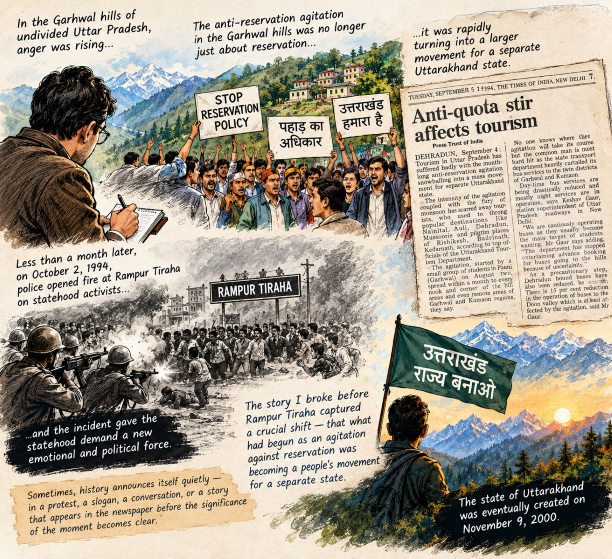
PrashantNews
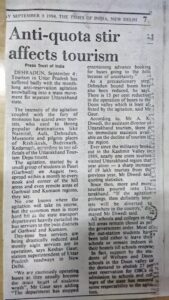
Less than a month before the firing on statehood activists at Rampur Tiraha on October 2, 1994, I broke a story that, in retrospect, captured a crucial turning point in the Uttarakhand movement.
The story was about something that was becoming increasingly visible across the Garhwal and Kumaon hills of undivided Uttar Pradesh: the anti-reservation agitation was no longer merely an agitation against the reservation policy. It was rapidly turning into a much larger movement for a separate Uttarakhand state.
At the time, it was important to recognise this shift: what had begun as an anti-reservation agitation was fast becoming a movement for a separate Uttarakhand state.
The immediate trigger for the protests was the Uttar Pradesh government’s decision on reservations. Demonstrations, road blockades and protests had spread across the hill districts. But while reporting from Dehradun, I began to see that the anger was acquiring a much broader political character. The reservation issue was becoming a rallying point for a longstanding sense of political and administrative alienation in the hills.
My report highlighted this emerging shift — that what had begun as an agitation over reservations was acquiring the contours of a mass statehood movement.
This was before Rampur Tiraha changed the course of the movement.
On the night of October 1 and the morning of October 2, thousands of Uttarakhand activists travelling towards Delhi to press their demand for a separate state were stopped at Rampur Tiraha near Muzaffarnagar. The police firing and allegations of assault on protesters became a defining moment in the history of the Uttarakhand movement.
The events at Rampur Tiraha gave the statehood demand a new emotional and political force. The issue could no longer be viewed simply through the prism of the reservation controversy. For many people in the hills, the events reinforced the belief that their political and administrative grievances could not be addressed within the existing structure of Uttar Pradesh.
Looking back three decades later, that story remains significant to me not because it predicted what would happen, but because it recorded a change that was already taking place on the ground.
Journalism often involves recognising a larger story while it is still taking shape. In the Garhwal and Kumaon hills in September 1994, the signs were there: the slogans were changing, the nature of the protests was changing, and increasingly, the demand was not simply about reservation.
It was about a state of their own.
The state of Uttarakhand was eventually created on November 9, 2000, six years after the events of 1994. It was also a coincident that I was sent to Dehradun from New Delhi as Bureau Chief of PTI news agency for which I was working at that time.
For a journalist who had reported that the anti-reservation agitation was turning into a statehood movement weeks before Rampur Tiraha, the period remains a reminder of how history sometimes announces itself quietly — in a protest, a slogan, a conversation, or a story that appears in the newspaper before the significance of the moment becomes clear.