
 By Shishir Prashant
PrashantNews
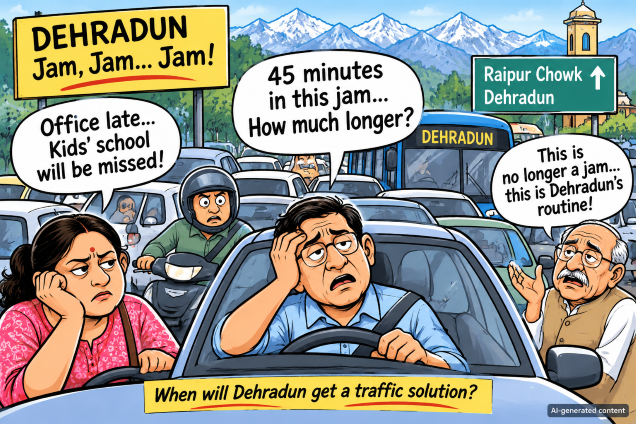
Dehradun’s burgeoning traffic problem has largely remained outside the political agenda, despite increasingly disrupting the daily lives of its residents. Senior Congress leader and former chief minister Harish Rawat has now become one of the first prominent politicians to publicly flag the issue after finding himself caught in a massive traffic snarl in the Raipur area of the city.
In a social media post on Saturday, Rawat said he had been stuck in traffic for 45 minutes while travelling from Ordinance Factory towards Raipur Chowk, which was still some distance away. Expressing frustration over the situation, he said it was difficult to predict how much longer it would take to get out of the jam and asked when Dehradun’s traffic management would finally be addressed. “Jam, jam and more jam… has become the destiny of Dehradun,” he wrote as
Rawat’s intervention has brought renewed attention to a problem that Dehradun-based social activist Anoop Nautiyal has been consistently highlighting. In a recent letter to Uttarakhand DGP Deepam Seth, Nautiyal proposed a structured Citizen Traffic Volunteer Force, called ‘Uttarakhand Traffic Sarthi’, to assist traffic police during periods of heavy congestion.
The scale of the problem is evident from vehicle registration figures. According to data obtained through an RTI application, 13,42,528 vehicles had been registered in the Dehradun, Rishikesh and Vikasnagar RTO areas by June 2025. Of these, 10,66,786 were registered in Dehradun alone. The three RTO areas accounted for nearly 36 per cent of all vehicles registered across Uttarakhand’s 13 districts.
Adding to the pressure, dedicated traffic police strength in Dehradun district has reportedly declined from 411 personnel in 2017 to 269 in November 2025, a fall of around 34 per cent.
Nautiyal has attributed the crisis to unplanned urban expansion, inadequate public transport, encroachments, road digging, malfunctioning traffic signals, tourism and VIP movements. He warned that congestion was affecting emergency response, public safety and economic productivity.
Under his proposed initiative, trained and verified volunteers would assist police with pedestrian movement, queue management and traffic flow at busy intersections, particularly during the peak tourist months of April, May and June.
He has also urged Chief Minister Pushkar Singh Dhami to personally intervene, strengthen police resources and consider setting up an Uttarakhand Commission for Traffic Management and introducing a Graded Response Action Plan (GRAP).
With Dehradun’s vehicle population continuing to grow, the concerns raised by Rawat and Nautiyal underline an uncomfortable question: how long can the state afford to treat the capital’s traffic crisis as merely a daily inconvenience rather than a major governance challenge?
Important: But the larger question is whether Dehradun’s worsening traffic crisis will find a place in the political agenda as Uttarakhand heads towards Assembly elections early next year. Will political parties go beyond their usual electoral promises and make traffic management, better urban planning and strengthening of public transport part of their campaign agenda? With the BJP already gearing up for the 2027 polls and the Congress preparing to challenge it, the daily ordeal of thousands of commuters could emerge as an important test of how seriously political parties take urban governance. For now, whether traffic congestion will become an election issue or remain confined to occasional political statements is an open question.
Suggestion: Uttarakhand should set up a dedicated traffic police force for better management of the traffic