
 By Shishir Prashant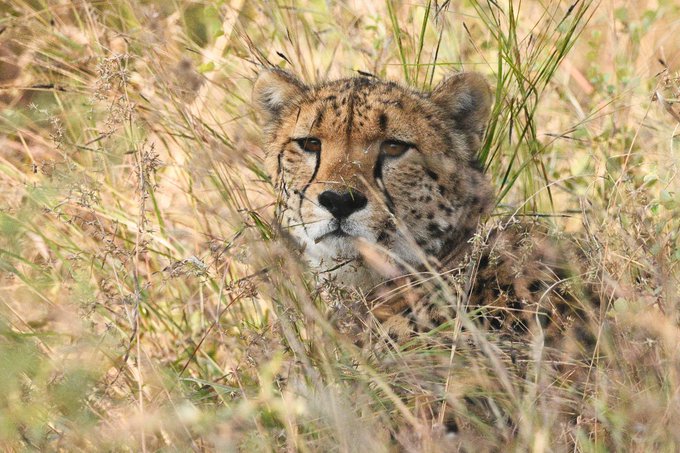
PrashantNews
Gamini, a female cheetah, is a new star attraction in Kuno National Park in Madhya Pradesh these days. In her exploratory phase of new life in Kuno, Gamini along with her four cubs, has already set a unique record covering a whopping 4000 sq km area in 194 days. She is the first cheetah in India to cover such a big distance.
And now, the five-year-old Gamini, who was brought from South Africa, is about to establish her new territory technically called home range in the wild.
Experts at the Dehradun-based Wildlife Institute of India (WII), who are continuously monitoring the cheetahs, said all of them have adapted to the new environment and are doing well.
Cheetahs were brought from the African continent in 2022-23 as part of a special project to reintroduce them to India after nearly 75 years of extinction.
Experts said all the cheetahs, including Gamini, are currently in the final stages of their exploratory phase. The exploratory area is gradually decreasing before they settle down in their new home range. “The Project Cheetah is rapidly progressing towards success,” said Dr Bilal Habib, a top scientist of the WII.
In a new study “Steps Before the Sprint: Initial Movement and Habitat Selection of Free-Ranging Cheetahs in Kuno National Park, Madhya Pradesh,” Maulik Sarkar, Senior Project Associate of the WII, said all the cheetahs have adapted to the new conditions. The prey base in Kuno is sufficient and is gradually increasing. Cheetahs’ movements in the surrounding villages are also considered safe.
“The environment and conditions for cheetahs in Kuno are similar to those of the forests of Africa. The mix of grasslands and forests in Kuno is the preferred habitat of cheetahs,” said Sarkar.
Three cheetahs, who were recently shifted from Kuno to Gandhi Sagar Wildlife Sanctuary, are also doing well. Currently, the total number of cheetahs is 27, of which 24 are in Kuno National Park and 3 in Gandhisagar.
Dr Habib said “although it will take at least 20-25 years to assess the success of the cheetah project, we can definitely say that it is rapidly progressing towards success.” Cheetahs are breeding well and have already produced more cubs than the total number brought from Africa, he said.
All the cheetahs are fitted with radio collars and being monitored around the clock by WII experts to ensure that the plan to maintain their long-term presence in India should not go awry.
The WII study revealed significant variation in cheetah exploratory behavior. Female cheetahs roamed in an area ranging from 275 to 4,870 square km in the forest, while mothers of sub-adult (under two years of age) cubs explored larger areas. Adult males living in coalition limited their exploratory activities to smaller areas, approximately 1,021 sq km while sub-adult males cover an average of 1,735 sq km of area.
On Sept 17, 2022, Prime Minister Narendra Modi released eight cheetahs brought from Namibia into a special enclosure at Kuno. It marked the world’s first inter-continental relocation of a large wild carnivore species and also the beginning of the project Cheetah in India.