 By Shishir Prashant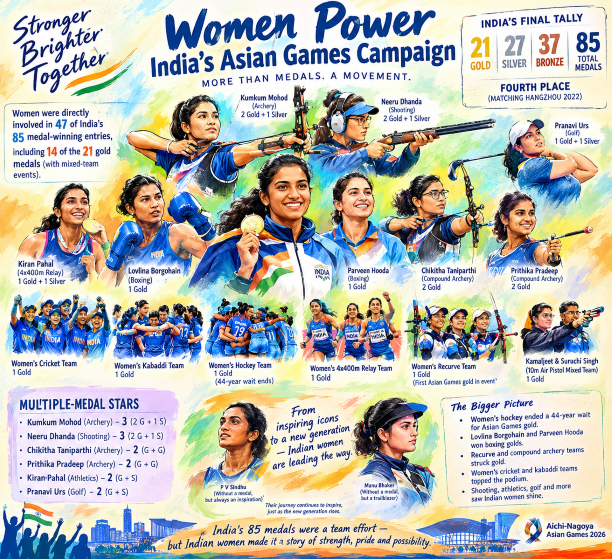
PrashantNews
If India’s 85-medal haul at the Aichi-Nagoya Asian Games is a measure of the country’s growing sporting strength, the performance of its women athletes is perhaps the clearest sign of that rise.
Indian women were directly involved in 47 of the country’s 85 medal-winning entries, including 14 of the 21 gold medals, when mixed-team events featuring Indian women are included. Their contribution stretched across cricket, kabaddi, hockey, athletics, shooting, archery, boxing, golf and other disciplines.
India finished fourth with 21 gold, 27 silver and 37 bronze medals, matching its position at the Hangzhou Games. Although the tally was below the record 107 medals won at Hangzhou, it was India’s second-highest medal haul at an Asian Games, comfortably ahead of the 70 won at Jakarta-Palembang in 2018.
The women’s gold-medal winners included the women’s cricket and kabaddi teams, the women’s hockey team, Lovlina Borgohain and Parveen Hooda in boxing, Pranavi Urs in golf, Kumkum Mohod in individual recurve archery, Neeru Dhanda in shooting, the women’s recurve and compound archery teams, and the women’s 4x400m relay quartet of Kiran Pahal, Poovamma Machettira, Prachi Choudhary and Vithya Ramraj.
Women were also part of India’s gold-medal-winning mixed events. Kamaljeet and Suruchi Singh combined for the 10m air pistol mixed-team gold, Neeru Dhanda and Kynan Chenai won mixed-team trap gold, while Chikitha Taniparthi and Sahil Jadhav took mixed compound archery gold.
Multiple-medal stars
Among the biggest stars of India’s campaign was Kumkum Mohod, who returned from her maiden Asian Games with three medals — two golds and a silver. She was part of the women’s recurve team that won gold, combined with Dhiraj Bommadevara to take silver in the mixed recurve team event, and then produced one of the defining moments of the Games by winning individual recurve gold.
Neeru Dhanda also finished with three medals — two golds and a silver. She won the women’s trap title, teamed up with Kynan Chenai for mixed trap gold and was part of the women’s trap team that took silver.
Chikitha Taniparthi won two golds in compound archery — in the women’s team event alongside Jyothi Surekha Vennam and Prithika Pradeep, and in the mixed team event with Sahil Jadhav.
Prithika Pradeep also won two golds, contributing to the women’s compound team and mixed compound team victories.
In athletics, Kiran Pahal was another multiple-medal winner, taking gold as part of the women’s 4x400m relay team and silver in the mixed 4x400m relay.
Golfer Pranavi Urs produced another landmark performance, winning gold in the women’s individual event and becoming the first Indian woman to win an individual Asian Games golf gold. She had earlier helped India take silver in the women’s team event.
Women who made history
The women’s campaign was not merely about numbers.
The Indian women’s hockey team ended a 44-year wait for Asian Games gold, defeating China 1-0 in the final and securing direct qualification for the 2028 Los Angeles Olympics.
Lovlina Borgohain became only the second Indian woman boxer after Mary Kom to win Asian Games gold, taking the women’s 75kg title, while Parveen Hooda added another women’s boxing gold in the 65kg category.
The women’s recurve team of Ankita Bhakat, Kirti Sharma and Kumkum Mohod won India’s first Asian Games gold in the event. The women’s compound trio of Jyothi Surekha Vennam, Prithika Pradeep and Chikitha Taniparthi also struck gold.
The women’s 4x400m relay team of Kiran Pahal, Poovamma Machettira, Prachi Choudhary and Vithya Ramraj added another athletics gold, while the women’s cricket and kabaddi teams successfully climbed to the top of the podium.
The contribution was equally visible in shooting, where Kamaljeet and Suruchi Singh combined for the 10m air pistol mixed-team gold, while Neeru’s mixed-trap triumph added another title.
The geographical spread
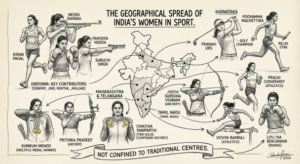
The geographical spread of the women’s success was equally striking, although Haryana emerged as one of the biggest contributors. Kiran Pahal of Sonipat, shooter Neeru Dhanda of Jind, boxer Parveen Hooda of Rohtak and shooter Suruchi Singh of Jhajjar all played key roles in India’s gold-medal campaign. Maharashtra produced multiple-medal winner Kumkum Mohod of Amravati and archer Prithika Pradeep of Mumbai, while Telangana’s Chikitha Taniparthi returned with two golds. Golf champion Pranavi Urs and relay star Poovamma Machettira represented Karnataka, Jyothi Surekha Vennam came from Andhra Pradesh, Prachi Choudhary from Uttar Pradesh, Vithya Ramraj from Tamil Nadu and Lovlina Borgohain from Assam. The spread underlined that the rise of Indian women in sport is no longer confined to a handful of traditional sporting centres.
Sindhu and Bhaker: Inspirations for others
There were also two notable disappointments in India’s women’s campaign, with P V Sindhu and Manu Bhaker finishing without a medal in Aichi-Nagoya. But their presence in the Indian sporting story goes far beyond one medal-less Games. Both have been inspirations for a generation of young Indian athletes, showing that Indian women can compete and win at the highest level.
In that sense, the emergence of a new group of women medal winners in Aichi-Nagoya is also part of the legacy of pioneers such as Sindhu and Bhaker. While they could not add to their own medal collections this time, the success of the younger generation underlines how far Indian women’s sport has come of age.
India’s Asian Games campaign was therefore about much more than its 85 medals and fourth-place finish. It was a powerful demonstration of the depth of Indian women’s sport — with established champions providing the inspiration and a new generation increasingly taking centre stage.