
 By Shishir Prashant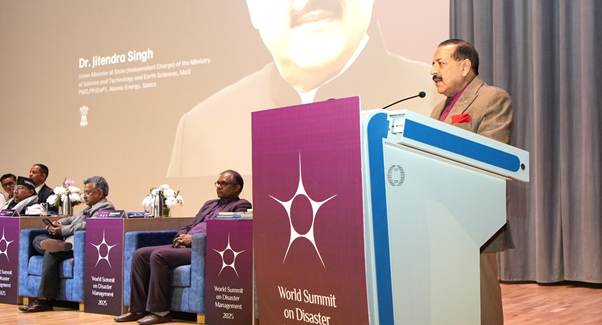
PrashantNews
Concerned over a series of disasters hitting Uttarakhand during the monsoon season, the centre has warned the hill state that illegal mining along riverbeds and near newly constructed highways is becoming a dangerous man-made threat, eroding foundations and amplifying flash flood impacts, and urged communities to recognise that short-term gains often lead to long-term destruction.
Addressing the “World Summit on Disaster Management in Dehradun, Union Minister of State (Independent Charge) for Science & Technology; Minister of State for Earth Sciences; Personnel, Public Grievances, Pensions, Atomic Energy and Space, Dr. Jitendra Singh also expressed concern over the lack of compliance in some regions with IMD alerts. He highlighted the need for stricter administrative response. He recalled a recent incident in Jammu & Kashmir where a newly appointed IAS officer prevented a major tragedy by immediately shutting down the highway following a red alert issued by IMD, demonstrating how timely action can save lives.
Dr. Singh elaborated that the centre has significantly expanded Uttarakhand’s meteorological and disaster-monitoring infrastructure over the last ten years. He informed that 33 meteorological observatories, a network of radiosonde and radio-wind systems, 142 automatic weather stations, 107 rain gauges, district-level and block-level rainfall monitoring systems, and extensive app-based outreach programmes for farmers have been established to improve early warning dissemination. He said that three weather radars have already been installed at Surkanda Devi, Mukteshwar and Lansdowne.
He announced that three more radars will soon be commissioned at Haridwar, Pantnagar and Auli, further strengthening real-time forecasting capability for the region.
The Minister stated that the centre has initiated a specialised Himalayan climate study programme to analyse the conditions that trigger sudden cloudbursts, with the objective of generating predictive indicators for vulnerable districts.
He mentioned that the “Nowcast” system, which provides a three-hour forecast and has been successfully used in major metros, is now being expanded across Uttarakhand to provide timely alerts to administrations and communities. He also highlighted the coordinated efforts of NDMA, the Ministry of Earth Sciences and several scientific institutions in developing advanced forest fire weather services, describing it as a whole-of-government and whole-of-science model for climate resilience.
Dr Singh said that scientific analyses point to a combination of climate change impacts, rapidly retreating glaciers, glacier-lake outburst risks, the fragile Himalayan Mountain system, deforestation, and man-made encroachments that obstruct natural drainage paths. The Minister highlighted that hydrometeorological hazards in Uttarakhand have risen sharply over the past decade, with the 2013 Kedarnath cloudburst and the 2021 Rishiganga disaster marking decisive turning points.