
 By Shishir Prashant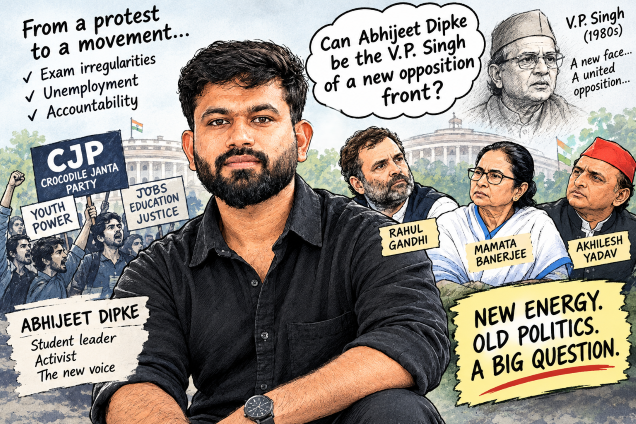
PrashantNews
India’s opposition has no shortage of seasoned leaders, but it is still searching for a figure who can turn public discontent into a compelling national movement. The emergence of Abhijeet Dipke, founder of the Cockroach Janta Party (CJP), has raised an intriguing question: could a young leader like him achieve what the established opposition has so far struggled to accomplish—and emerge as a new V.P. Singh of a united political front?
Dipke has emerged as a prominent face of youth-led protests in recent months. What began as a satirical online response to a controversial remark about unemployed young people grew into a movement addressing examination irregularities, unemployment and accountability. The protests culminated in the resignation of Union Education Minister Dharmendra Pradhan, giving the movement a significant political breakthrough.
Dipke’s growing visibility presents an uncomfortable challenge for the INDIA bloc. Established opposition leaders possess political experience, organisational networks and electoral machinery, but have struggled to convert public discontent into a sustained, nationwide mobilisation. The emergence of a young protest leader raises the question of whether the opposition needs to rethink on its new future plans or continue to squabble over petty issues.
The comparison with V.P. Singh is tempting. In the late 1980s, Singh became the rallying point for a diverse opposition united by an anti-corruption campaign against Prime Minister Rajiv Gandhi. VP Singh’s charisma helped a lot to bring together political forces that otherwise had little in common. Could Dipke provide a similar rallying point for a new coalition built around jobs, education, recruitment reforms, democratic accountability and the aspirations of young Indians?
There are, however, important differences. V.P. Singh was an experienced politician who broke away from Congress and possessed an established political network. Dipke’s strength, by contrast, lies in his ability to mobilise young people and communicate outside traditional party structures. Moreover, he has previously said that CJP intends to remain a pressure group rather than become an electoral party.
The opposition therefore faces a choice about how to engage with this emerging movement. It could offer meaningful cooperation while respecting its independence, or risk appearing threatened by a new generation unwilling to accept the old political hierarchy. Equally, elevating one individual prematurely could burden a young movement with expectations it may not yet be equipped to meet.
The real test is whether Dipke’s movement can sustain its momentum beyond individual protests and whether established parties can work with it without seeking to appropriate its credibility.
India may not need another political messiah. It may need a new political arrangement in which fresh leadership, public movements and experienced politicians work together on a common programme. Whether Dipke can become a V.P. Singh-like figure will depend on his organisational staying power, political judgement and the willingness of established leaders to make room for change.