 By Shishir Prashant
PrashantNews
Field Marshal Sam Manekshaw once said “if a man says he is not afraid of dying, he is either lying or he is a Gurkha.” Nepal is indeed the land of the brave Gurkhas, who are great warriors.
At the same time, Nepal is also the land of Budha, an apostle of peace. But there is hardly any peace ever since the 2001 Nepalese royal massacre of King Birendra, his wife Aishwarya and some other members of the family by a drunk crown Prince Dipendra Bir Bikram Shah before he turned the gun on himself.
Within a short period of a few hours, Nepal’s royal family was almost wiped out. Dipendra wasn’t a ruler for long. He was declared brain dead and his uncle Gyanendra became Nepal’s third King in three days.
But the massacre kicked off a turbulent period in Nepal that culminated in the end of the country’s monarchy seven years later. Even the democracy in Nepal could not put an end to the turmoil that kept coming again and again.
Just like the royal massacre of 2001, the upheavals in the landlocked Himalayan nation this time turned so violent that within 24 hours everything changed with Prime Minister K P Sharma Oli beating a hefty retreat sending his resignation to the President.
Nepal was quiet on Monday morning. A large number of people held prayers at the Pashupatinath temple in Kathmandu. Prime Minister Oli too watched TV and had his breakfast.
Oli was preparing to meet some visitors when, all of a sudden, he got the shocking news that widespread protests have broken out in Kathmandu against his decision to ban 26 social media platforms.
All these spontaneous protests were not much different from what had happened in many East European nations in early 1990s and recently in Bangladesh.
Soon Nepal was in the grip of unrest as the protests spiralled to reflect broader discontent with the Gen Z calling for the ouster of Oli, who was heading a left party government. “We don’t want just TikTok, give us all (Facebook and other social platforms),” was a common slogan when protests began in Kathmandu streets.
The Nepalese government has accused all social media platforms of failing to register with regulators in the wake of large-scale complaints of hate speech, misinformation and fraud. TikTok was the only major platform to comply and remains accessible,
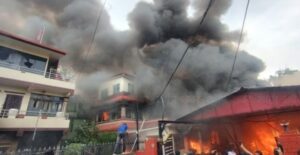
But on Tuesday, the protests took the shape of a revolt against Prime Minister Oli. Within a short gap of one day, Oli was forced to resign but not before large-scale arson and killings which turned into full-blown conflagration. The mobsters torched Parliament and Supreme Court and several other buildings and did not spare even elderly men and women. Wife of former Prime Minister Jhalanath Khanal was burnt alive when their house was set on fire. Nepal also paid a heavy price as over 22 youths were killed and 300 others injured during the clashes with security forces.
On Tuesday evening, Nepal’s army chief, General Ashok Raj Sigdel, issued a statement accusing demonstrators of taking advantage of the current crisis by damaging, looting and setting fire to public and private property. If unrest continued, the statement said, “all security institutions, including the Nepal Army, are committed to taking control of the situation.”
Prime Minister Narendra Modi too issued a statement calling for peace in Nepal. But after the two days of horror, one big question still remains unanswered – what next? The violence may subside but who will end the menace of the widespread nepotism, corruption and unemployment in Nepal, the actual triggers behind the unrest.
For the time being, Kathmandu Mayor Balendra Shah is the man of the moment as the rapper-turned politician has now become the face of the Gen Z movement.