
 By Shishir Prashant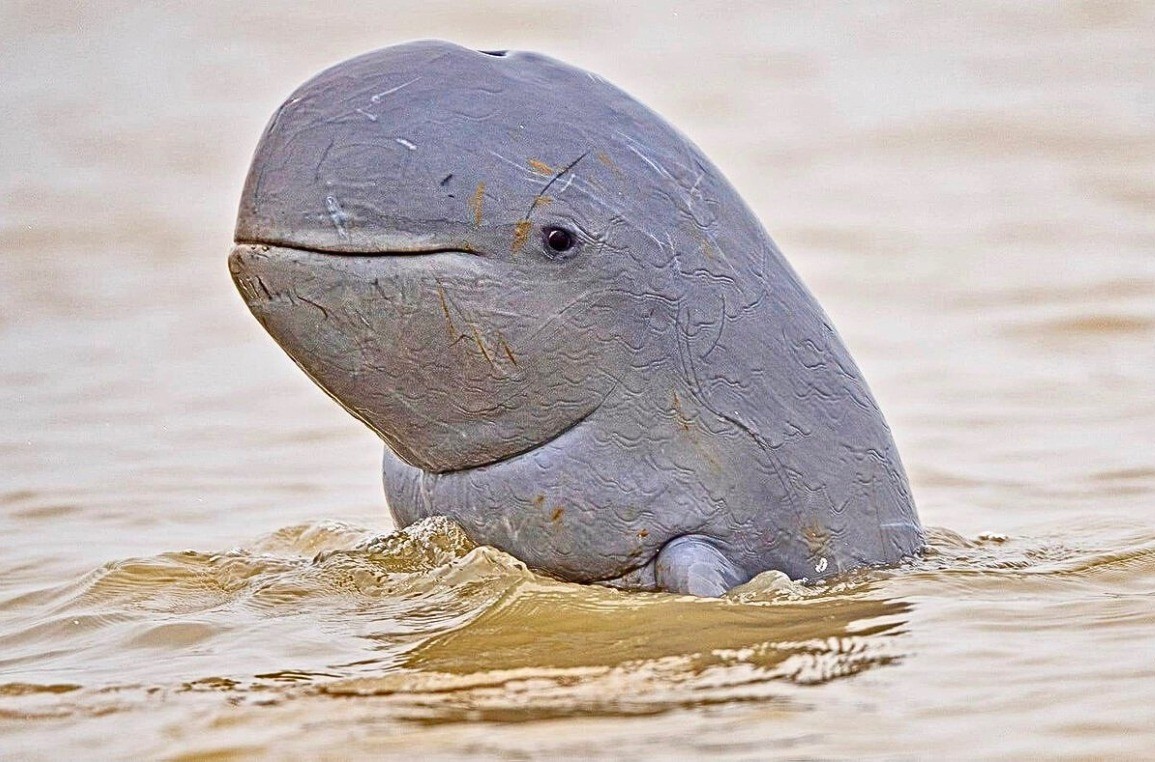
PrashantNews
India has launched its second comprehensive river survey on dolphins which have an irresistible charm for people especially through their diving abilities.
The survey which began from Bijnor in Uttar Pradesh with the support of Dehradun-based Wildlife Institute of India (WII), will focus for first time on the population of Irrawaddy dolphins (Orcaella brevirostris), noted for its bulbous, rounded head and beluga-like features.
The Irrawaddy dolphin is a euryhaline species of oceanic dolphin found in scattered subpopulations near sea coasts and in estuaries and rivers in parts of the Bay of Bengal and Southeast Asia. It closely resembles the Australian snubfin dolphin (of the same genus, Orcaella), which was not described as a separate species until 2005. It has a slate blue to a slate grey colour. Although found in much of the riverine and marine zones of South and Southeast Asia, the concentrated lagoon population is found in Chilika Lake in Odisha.
The second survey will additionally cover new stretches and operational areas to include a new species, Irrawaddy dolphin, estimation in Sundarbans and Odisha. This expanded spatial coverage will help update population estimates for this species, assess threats and habitat conditions and support improved conservation planning under Project Dolphin, top officials said.
Following up the release of population estimation result of first round by the Prime Minister in the National Board for Wild Life (NBWL) at Gir in March last year, and to take forward the conservation of Dolphins in the country, the Union Ministry of Environment, Forest and Climate Change rolled out the second rangewide estimation of riverine and estuarine dolphins under Project Dolphinfrom Bijnor, Uttar Pradesh.
The survey commenced with 26 researchers in three boats, recording ecological and habitat parameters, and using technologies such as hydrophones for underwater acoustic monitoring. In the first phase, the survey will cover the main stem of the Ganga from Bijnor to Ganga Sagar and the Indus River. In the second phase, it will cover Brahmaputra, the tributaries of the Ganga, the Sundarbans, and Odisha.
Apart from the Ganges River Dolphin, the survey will assess the status of the Indus River Dolphin along with habitat condition, threats, and associated conservation-priority fauna. This initiative will generate robust scientific data to support evidence-based conservation planning and policy action for India’s river ecosystems.
The previous nationwide survey (2021–23) recorded an estimated around 6,327 riverine dolphins in India, including Ganges River Dolphins in the Ganga, Yamuna, Chambal, Gandak, Ghaghara, Kosi, Mahananda and Brahmaputra systems, and a small population of Indus River Dolphins in the Beas. Uttar Pradesh and Bihar accounted for the largest numbers, followed by West Bengal and Assam, highlighting the critical importance of the Gangetic basin for long-term dolphin conservation.
Pic: An Irrawaddy dolphin