
 By Shishir Prashant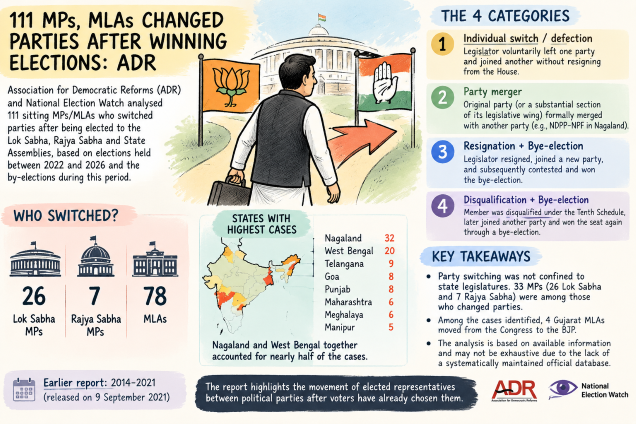
PrashantNews
The Naga People’s Front (NPF) emerged as the biggest recipient of lawmakers who changed political parties after winning elections between 2022 and 2026, accounting for 32 of the 111 MPs and MLAs identified in an analysis by the Association for Democratic Reforms (ADR) and National Election Watch.
The NPF, which is a ruling party in Nagaland, was followed by the BJP with 29 lawmakers and the Nationalist Citizens Party of India (NCPI) with 20. The Congress received nine, Shiv Sena eight, the National People’s Party (NPP) six and the People’s Party of Arunachal (PPA) four. The NCPI is a registered unrecognised party that has participated in state assembly elections, with a focus on representing the Bengali-speaking communities.
Together, the NPF, BJP and NCPI accounted for 81 of the 111 lawmakers, or 73%, who moved to other political parties during the period. In other words, 111 sitting MPs and MLAs changed political parties after winning their elections between 2022 and 2026, according to the analysis.
The NPF’s position is closely linked to the political realignment in Nagaland. ADR’s analysis found that 25 lawmakers originally elected from the Nationalist Democratic Progressive Party (NDPP) were among those who changed parties. The NDPP merged with the NPF in October 2025, with the Election Commission of India formally recognising the merger in May 2026.
Following the merger, Chief Minister Neiphiu Rio became leader of the NPF Legislature Party, while the NPF joined the ruling People’s Democratic Alliance in Nagaland alongside the BJP.
The ADR data also shows that party switching was concentrated in a few major political realignments. Nagaland recorded the highest number of cases at 32, followed by West Bengal with 20 and Telangana with nine.
West Bengal presents another striking example. All 20 lawmakers identified from the state were Lok Sabha MPs originally elected on Trinamool Congress tickets who subsequently moved to the NCPI, according to the analysis. The report notes that the MPs have described the move as a merger, with the matter before the Lok Sabha Speaker.
On the other side of the equation, the NDPP recorded the highest number of exits at 25, followed by the All India Trinamool Congress with 20 and the Congress with 19. Together, these three parties accounted for 64 of the 111 cases, or 58%.
The analysis covered 26 Lok Sabha MPs, seven Rajya Sabha MPs and 78 MLAs and classified the cases into individual switches, party mergers, resignations followed by by-elections, and disqualifications followed by by-elections. ADR has cautioned that the list may not be exhaustive because there is no systematically maintained official database of such political changes.