
 By Shishir Prashant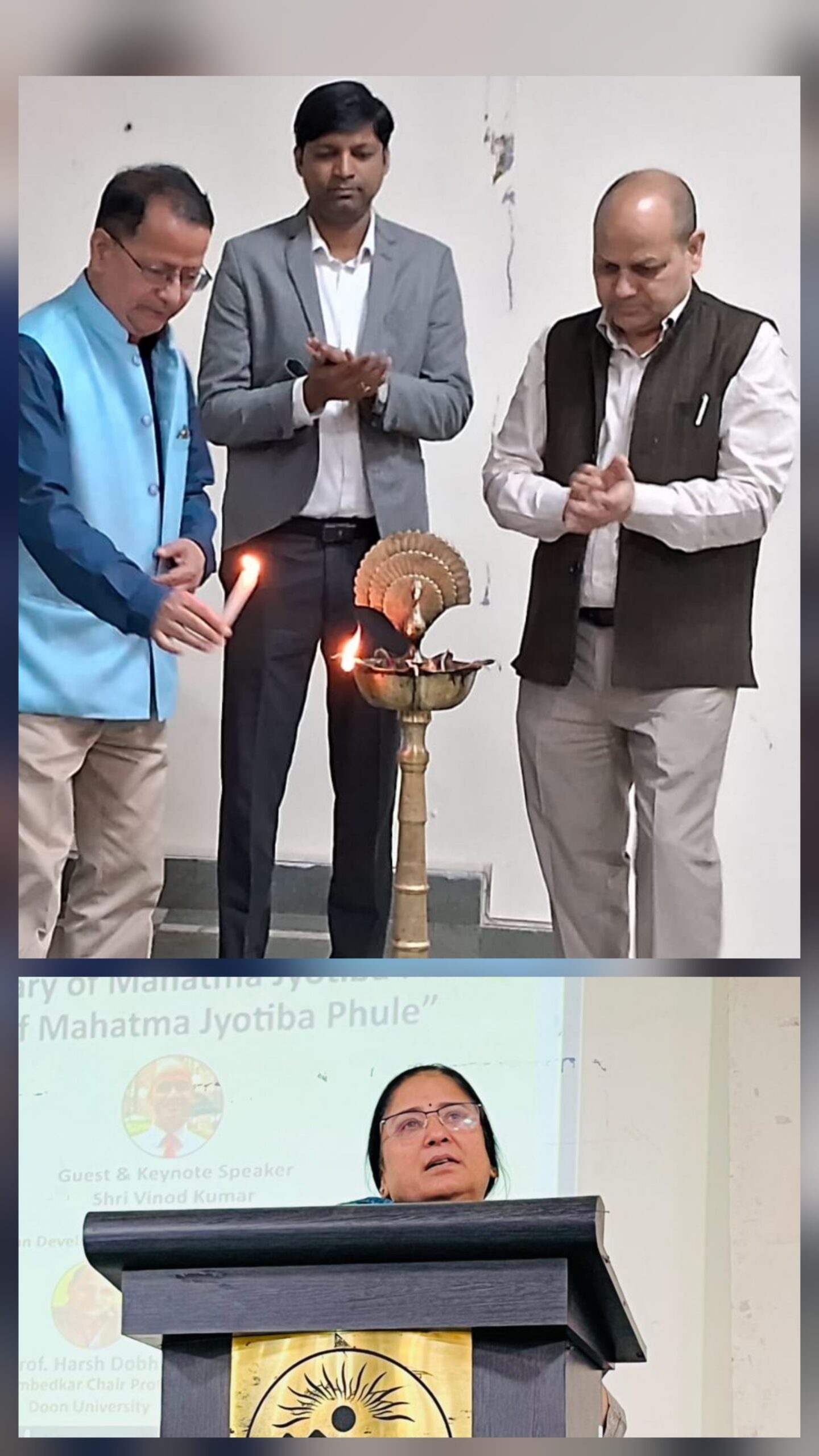
PrashantNews
Doon University Saturday commemorated the 200th Birth Anniversary of Mahatma Jyotiba Phule paying floral tributes with a special lecture and discussion on his life, work and philosophy.
The event brought together academicians, students, and policymakers to reflect on Mahatma phule’s enduring contributions to education, social justice, and equality.
Vice Chancellor Prof Surekha Dangwal emphasized that Mahatma Phule’s ideas remain deeply relevant in contemporary India. She noted that Phule’s vision of education as a tool of empowerment continues to guide institutions toward inclusive and equitable development. Prof Dangwal highlighted the importance of expanding educational opportunities for women and marginalized communities as the foundation for social transformation.
Delivering the keynote address, Vinod Kumar, a senior officer in the Urban Department with the Govt of Uttarakhand, stressed that commemorations must go beyond ceremonial observances and translate into meaningful academic deliberations. He highlighted Phule’s contributions to fighting discrimination, empowering women, promoting rational thinking, strengthening agriculture, and encouraging literature.
Dean of School of Social Sciences, Prof R. P. Mamgain highlighted that Mahatma Phule’s legacy is intergenerational and transformational. He observed that Phule challenged myths and social hierarchies through education and emphasized self-respect as the cornerstone of empowerment.
Dr Ambedkar Chair, Prof Harsh Dobhal underlined Phule’s rationalist philosophy and his efforts to dismantle caste-based inequalities. He highlighted Phule’s emphasis on questioning social norms, promoting women’s empowerment, and advocating scientific approaches in agriculture and rural development. Prof Dobhal said that Mahatma Phule, a visionary social reformer, regarded education as the most powerful tool against oppression and famously argued that lack of education leads to lack of wisdom, which ultimately results in poverty and exploitation.
Prof Achlesh Daverey noted that in keeping with the message and principles of Mahatma Phule, we should remember that no society can progress without empowerment of women and treating them as equal partner in development and progress of the nation.
Prof Ashish Kumar emphasized that sustainable social development requires inclusive participation and representation. He highlighted the importance of incorporating women’s perspectives and understanding social change from multiple viewpoints to build equitable societies, echoing Phule’s inclusive vision.
In his concluding remarks, Dr. Sudhanshu Joshi emphasized the continued relevance of Phule’s ideas in modern governance and policy frameworks. He highlighted that education, equality, and rational thinking remain essential pillars for democratic and inclusive development.
Those who attended the programme included Dr Manvendra Barthwal, Dr Saumyata Pande, Dr Ajit Panwar, Ms Divyanjali Bijalwan, Ms Tanuja Joshi and a number of faculty members, research scholars and students.
The programme was jointly organised by Dr Ambedkar Chair and E-Çell, CIIEIR, Centre of Excellence supported by Department of Higher Education under Devbhoomi Udyamata Yojna.
Mahatma Jyotiba Phule, a visionary social reformer, regarded education as the most powerful tool against oppression. He argued that lack of education leads to lack of wisdom, which ultimately results in poverty and exploitation. In 1848, he revolutionized Indian society by opening the first school for girls in Pune and, along with Savitribai Phule, pioneered inclusive education for marginalized communities. Through the establishment of Satyashodhak Samaj, he encouraged rational thought, social equality, and critical inquiry.