
 By Shishir Prashant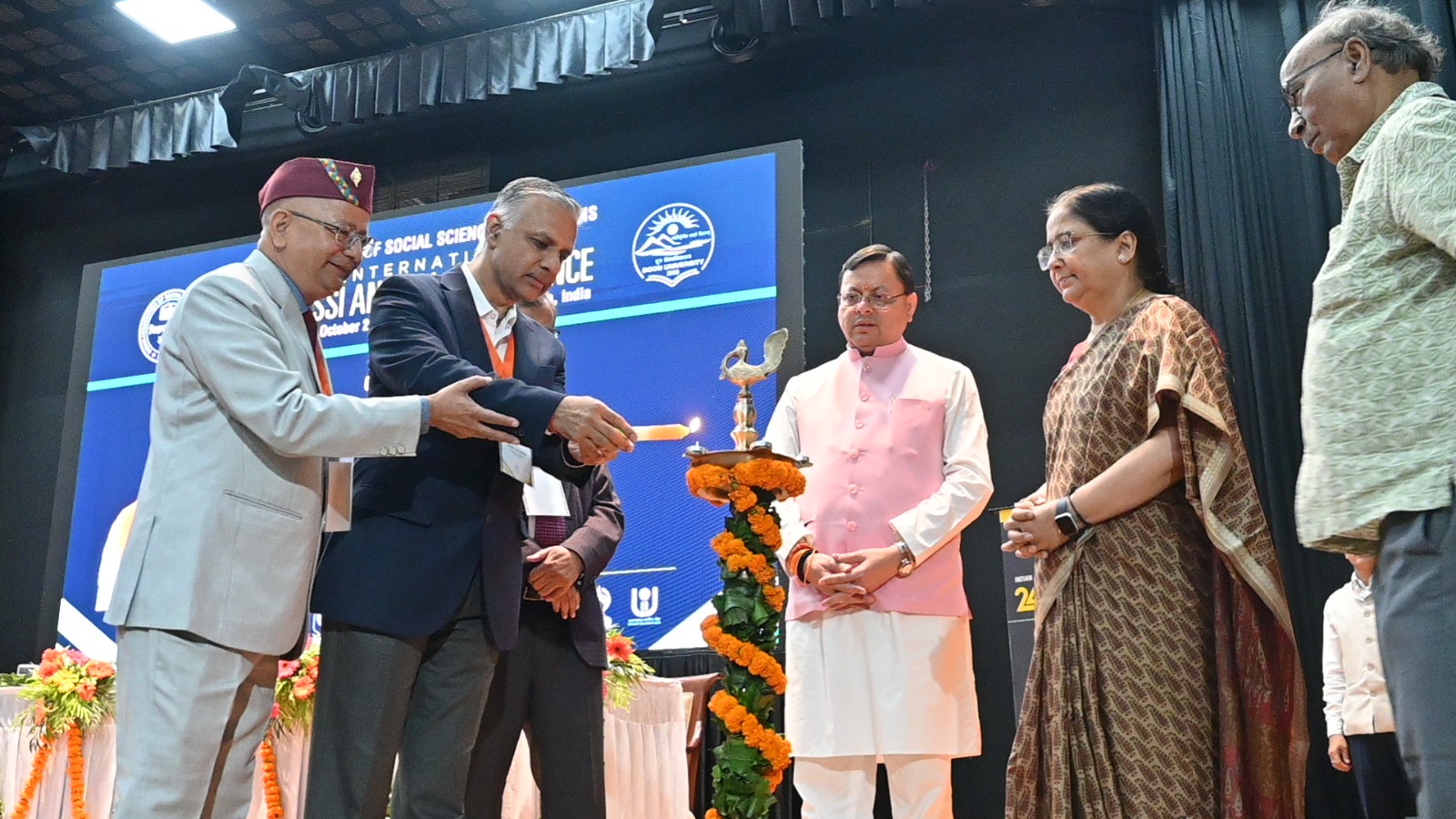
PrashantNews
Uttarakhand Chief Minister Pushkar Singh Dhami on Friday reaffirmed his government’s commitment for sustainable development in view of a series of recent disasters in the state.
“The government is working with full commitment and determination to achieve the sustainable development goals by maintaining economic, social, and environmental stability in the state. The government has launched a nine-point policy to ensure a balance between economy and ecology, which is an important initiative towards achieving the sustainable development goals,” Dhami said.
The Chief Minister was speaking at the inauguration of the 24th Annual Conference of the Indian Association of Social Science Institutions (IASSI), which began at Doon University. The three-day national conference has brought together over 400 delegates from across India, including eminent social scientists, researchers, and policymakers, to deliberate on issues related to sustainable development, climate resilience, and livelihood security, particularly in the context of the Himalayan region.
In his address, Chief Minister Dhami highlighted the government’s continued focus on social justice, poverty alleviation, and inclusive development. He stressed the state’s commitment to adopting emerging technologies, such as Artificial Intelligence, to respond effectively to the increasing frequency of natural disasters and the broader impacts of climate change, especially in vulnerable ecological zones like Uttarakhand.
Welcoming the delegates, Doon University Vice Chancellor Prof. Surekha Dangwal underlined the critical relevance of the conference themes, which include climate change, urbanization, and livelihood enhancement. She emphasized the university’s role in generating evidence-based research that has directly informed public policy, and noted that such academic contributions have previously been integrated into state-level decision-making. Prof. Dangwal also acknowledged the Chief Minister’s initiative in introducing Hindu Studies as an academic program at Doon University. She further commended the Uttarakhand government’s innovative, self-sustaining initiatives aimed at empowering women, particularly in the hill regions.
Delivering the presidential address, Prof. Ramesh Chand, Member of NITI Aayog, noted that India’s agricultural output remains stable and on a rising trajectory despite the mounting pressures of climate change. He attributed this resilience to the diversification of crops, expansion of irrigation infrastructure, and sustained investment in agricultural research and development.
Prof. Chand also presented a detailed statistical analysis of development in India’s hill states, highlighting Sikkim as a standout model with a per capita income over three times the national average. He pointed out that Uttarakhand faces growing concerns over fallow land, driven primarily by migration from rural areas, and urged focused efforts in horticulture and cluster farming to reinvigorate the rural economy and enhance agricultural productivity.
Addressing the conference, Prof. Sachin Chaturvedi, Vice Chancellor of Nalanda University and Chairman of IASSI, emphasized the need to bridge the gap between science and society, and to integrate social sciences with natural sciences. He cautioned against unethical research practices such as p-hacking—the manipulation of data to produce misleading statistical significance—which, he said, contributes to the growing reproducibility crisis in research. Prof. Chaturvedi also called for a decolonization of academic thought, encouraging scholars to move beyond Western-centric narratives and embrace India’s indigenous knowledge systems. Referencing legendary thinkers like Aryabhata and Nagarjuna, he highlighted India’s historical contributions to global science and mathematics, particularly the conceptualization of zero.
In his opening remarks, Prof. R.P. Mamgain, Dean of the School of Social Sciences at Doon University and Organising Secretary of the conference, introduced the central themes of the event—climate change and environmental challenges, urbanisation and sustainable development, and the enhancement of livelihoods and well-being. He expressed deep gratitude to the Hon’ble Chief Minister for his presence, which he said elevated the stature and importance of the event.
The conference, hosted by the Department of Economics, School of Social Sciences, is set to feature a wide range of expert-led discussions and research presentations addressing critical contemporary issues, including technology and culture in development, climate-induced livelihood vulnerabilities, green pathways for hill towns, and climate-resilient urban planning and waste management in Uttarakhand.
The Valedictory Session, scheduled for October 12, will be addressed by Uttarakhand Governor Lt Gen (Retd) Gurmit Singh, who will preside as Chairperson of the session.
Organized under the banner of IASSI, a national federation of academic institutions known for publishing the peer-reviewed IASSI Quarterly, the conference represents a crucial platform for bridging academic research with real-world policymaking. It aims to generate actionable insights and recommendations to support sustainable development and inclusive growth amidst escalating global and regional challenges.