
 By Shishir Prashant
PrashantNews
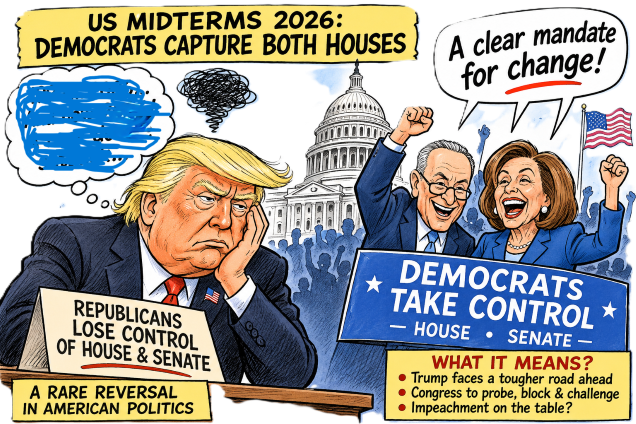
US President Donald Trump has suffered a major political setback after Democrats captured control of both chambers of Congress in the November 3 midterm elections, marking a rare instance in American political history when a sitting President’s party lost both the House of Representatives and the Senate halfway through his term.
The result puts Trump in a difficult political position for the remaining two years of his presidency, as Democrats prepare to use their control of Congress to scrutinise his administration, challenge his legislative agenda and investigate key government decisions, political analysts said.
The defeat is particularly significant against the backdrop of American electoral history. While the party occupying the White House routinely faces losses in midterm elections, losing control of both chambers simultaneously is a much rarer occurrence.
Over the past five decades, similar setbacks were suffered by Democratic President Bill Clinton in 1994 and Republican President George W. Bush in 2006, the analysts said.
In 1994, Republicans, led by Newt Gingrich and their ‘Contract with America’ campaign, captured both chambers, ending four decades of Democratic control of the House. Clinton’s Democrats lost 54 seats in the House and eight in the Senate.
Twelve years later, in 2006, Bush’s Republicans lost 30 House seats and six Senate seats, handing control of both chambers to Democrats amid public discontent over the Iraq War and criticism of the administration’s handling of Hurricane Katrina.
The 2026 outcome has now added Trump to this list of presidents who have faced a double loss of congressional control in midterm elections.
The Democratic gains have been attributed to voter dissatisfaction over the economy, inflation, rising living costs, Trump’s tariff policies and the prolonged war with Iran, which has contributed to higher fuel prices. The results also saw Democrats make significant advances in traditionally Republican strongholds.
The change in congressional control could have far-reaching consequences for Trump’s administration. Democrats will now have the authority to lead congressional committees, summon officials for questioning, issue subpoenas and launch investigations into government policies and decisions.
They could also block or significantly modify the President’s legislative proposals and subject his administration to sustained congressional scrutiny.
Impeachment proceedings against Trump could also become a possibility, although initiating impeachment in the House does not automatically mean removal from office. A conviction in the Senate requires a two-thirds majority of senators present, a threshold Democrats cannot reach with their current numbers.
Trump, however, will continue as President until January 2029, as the midterm elections do not affect the four-year presidential term.
The election has once again highlighted a distinctive feature of American democracy: voters can alter the balance of power in Congress halfway through a presidential term without changing the occupant of the White House.