 By Shishir Prashant
PrashantNews
The unprecedented scale of Ukraine’s latest drone assault on Russia is likely to be watched closely by defence planners around the world as a real-world test of one of modern warfare’s most difficult problems: how to defend against hundreds or even thousands of relatively cheap unmanned aircraft arriving in waves.
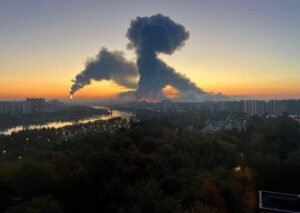
Ukraine launched more than 1,000 drones towards Russia, including hundreds aimed at Moscow, in what Russian authorities described as an unprecedented attack. Russia’s Defence Ministry said its forces destroyed or intercepted 1,110 Ukrainian drones across Russia, occupied Ukrainian territory and the Black Sea. Moscow, however, suffered damage to an oil refinery and a residential building, while two people were killed and 20 injured in the wider Moscow region, media reports said.
For defence experts, the headline figure of 1,110 interceptions is only part of the story. Russia has not publicly disclosed how many drones were destroyed by S-400 batteries, or by shorter-range air-defence systems, electronic warfare, fighter aircraft and other counter-drone weapons.
That distinction matters because the emerging lesson from Ukraine is that there is no single magic weapon against a mass drone attack, experts said.
NATO is already systematically studying the Ukrainian experience. Its Joint Analysis, Training and Education Centre in Poland works with Ukrainian personnel to capture battlefield lessons, while NATO’s Layered Counter-UAS Initiative is testing how different counter-drone systems can be integrated into a common network. In June 2026, NATO said the initiative was moving towards a scalable “mosaic” of interconnected counter-drone cells.
The economics of the battle are particularly important. NATO Secretary General Mark Rutte has warned that it is not sustainable to destroy a drone costing perhaps $1,000 or $2,000 with a missile costing hundreds of thousands or even a million dollars. NATO allies have therefore committed more than $40 billion over five years to counter-drone capabilities and training.
This is also why the S-400’s performance in Russia is being examined with interest. The system remains a formidable long-range air-defence weapon, but using expensive long-range missiles against massed low-cost UAVs creates an ammunition and cost-exchange problem. Recent analysis of Ukraine’s battlefield experience points towards layered defences combining guns, inexpensive interceptors, passive sensors, electronic warfare and selective use of advanced missiles against high-value targets.
The implications extend well beyond Russia and Ukraine. India, NATO members, China, Israel and other major military powers have strong incentives to study how drones penetrate, saturate or confuse sophisticated air-defence networks.
The latest attack therefore represents more than another episode in the Russia-Ukraine war. It is a live experiment in the future of air warfare.
The crucial question for defence planners is no longer simply whether an S-400, Patriot or another advanced missile system can shoot down a drone. It is whether an entire defence network can detect, classify and destroy hundreds or thousands of drones quickly enough—and at a cost that can be sustained for days or weeks.
That may ultimately determine the shape of air defence in the drone age. We should not forget that S-400s were hailed as victorious during the 2025 Indo-Pak drone skirmishes in Jammu.