
 By Shishir Prashant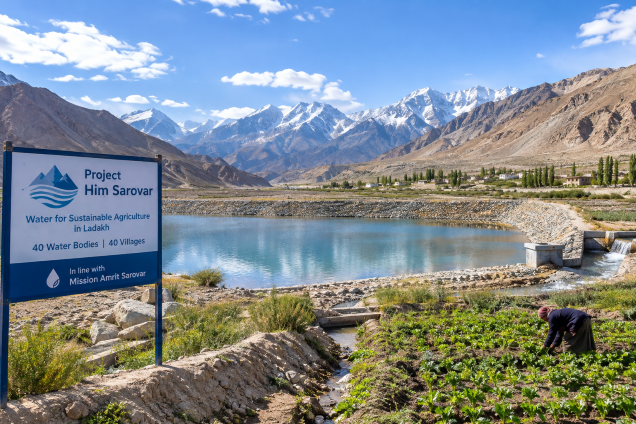
PrashantNews
In an arid region where water from melting snow and glaciers often flows away before farmers can use it when they need it most, 40 new water bodies across 40 villages are set to offer a practical solution to Ladakh’s irrigation woes.
Prime Minister Narendra Modi will inaugurate the water bodies developed under Project Him Sarovar on October 15 as part of five projects worth around ₹3,350 crore that he will inaugurate or dedicate to the nation via video conferencing on Oct 15.
The initiative seeks to address a peculiar challenge faced by farmers in the cold desert region: the mismatch between the availability of water and the agricultural season. While snowmelt and glacial runoff provide substantial water at certain times of the year, farmers often face shortages during sowing, when crops need timely irrigation.
Project Him Sarovar aims to bridge this gap by conserving water when it is available and storing it for use when agricultural demand rises. The water bodies are expected to support irrigation, protect farming livelihoods and strengthen long-term water security in villages spread across the high-altitude region.
Agriculture in Ladakh depends heavily on limited water resources, with scant rainfall and harsh climatic conditions making cultivation particularly challenging. The short growing season leaves farmers with little room for error: a shortage of irrigation water at the time of sowing can affect crop establishment and, ultimately, yields.
By improving local water storage, Him Sarovar seeks to make communities less vulnerable to seasonal shortages and help farmers use available water more effectively.
The project is aligned with the objectives of Mission Amrit Sarovar, which promotes the development and rejuvenation of water bodies to improve water conservation.
For Ladakh, where every drop of water can make a difference to agricultural production, the initiative represents an effort to turn seasonal snowmelt into a more dependable resource for farming. Its long-term impact will depend on the storage capacity of the water bodies, their maintenance and how effectively the conserved water reaches farmers when they need it most.