
 By Shishir Prashant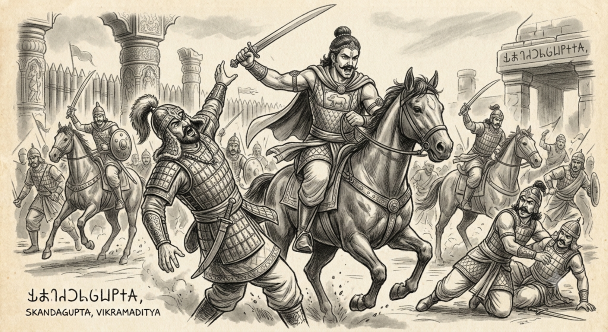
We are launching a new series on India’s unsung heroes, beginning with King Skandagupta, a remarkable ruler who defended the Gupta Empire against foreign invasions but remains largely forgotten in popular Indian history.
PrashantNews
More than 1,500 years ago, when Hunnic groups from Central Asia threatened powerful kingdoms across Eurasia, Gupta emperor Skandagupta emerged as a formidable defender of one of ancient India’s greatest empires. His resistance helped contain the Huna threat and appears to have bought the Gupta Empire several decades of relative security from major incursions.
In Europe, Attila’s Huns launched devastating campaigns against the Roman Empire. Farther east, the Hephthalites, commonly associated with the White Huns, rose to power across parts of Central Asia and Persia before expanding into the Indian subcontinent. Although these groups are often discussed collectively as Huns, their movements and campaigns were not all part of a single military advance.
Skandagupta ruled from around 455 to 467 CE and is generally regarded as the last great emperor of the Gupta dynasty. He was the son of Kumaragupta I, but historical records do not establish his exact birth date, his age when he became emperor or the identity of his mother.
His accession came at a difficult time. The empire faced internal challenges as well as threats from its northwestern frontiers. Skandagupta fought the Pushyamitra threat and confronted the Huns, whose mobility and military strength made them formidable opponents.
The Bhitari pillar inscription in present-day Uttar Pradesh celebrates Skandagupta’s military achievements and describes his conflict with the Hunas. The inscription presents him as a determined defender of his dynasty. Although the precise scale of his victories remains a subject of historical debate, the evidence indicates that his resistance helped preserve Gupta authority at a critical moment.
His victory appears to have bought the Gupta Empire decades of relative security. Inscriptions from the following years indicate that imperial authority remained effective across important parts of the empire. The Huns would eventually return in force, but Skandagupta’s resistance appears to have delayed their advance, giving the Gupta state valuable time to recover and continue its political and cultural life. Later Huna rulers, including Toramana and Mihirakula, would establish power in parts of northern India towards the end of the fifth and into the sixth century.
Skandagupta’s achievements extended beyond warfare. The Junagadh rock inscription in Gujarat records the restoration of the embankment of Sudarshana Lake after damage caused by heavy rains. The work was carried out under the supervision of Chakrapalita, son of provincial governor Parnadatta. It highlights the importance the administration attached to irrigation, agriculture and public infrastructure.
His reign also exposed the mounting pressures on the empire. The cost of military campaigns may have contributed to financial difficulties, although the extent of their impact remains debated. After Skandagupta’s death around 467 CE, probably followed by Purugupta, the Gupta Empire gradually weakened amid renewed external pressures and declining central authority.
The Gupta period is celebrated for achievements in mathematics, astronomy, literature, sculpture and architecture. Skandagupta inherited this rich cultural tradition and fought to preserve the political order that had helped sustain it. His contribution should therefore be seen not as the creation of the Gupta Golden Age, but as an important effort to defend its imperial foundations during a period of serious external threats.
Why should Indians remember Skandagupta? While he is less familiar to the wider public than Samudragupta or Chandragupta II, his reign offers an example of military resistance combined with the maintenance of administration and public works. By checking the Huna advance, he helped give the Gupta Empire a valuable period of continued stability, making him one of the significant defenders of ancient India’s imperial history.