
 By Shishir Prashant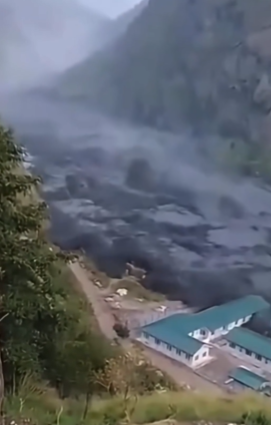
PrashantNews
A destructive flash flood that swept through Nepal’s Budhi Gandaki river system early Sunday may have been triggered by the failure of a temporary river blockage created by a landslide near Chumchet in Gorkha district, according to preliminary accounts from Nepal’s authorities reviewed by the International Centre for Integrated Mountain Development (ICIMOD).
Flooding is estimated to have begun around 4:00 a.m. Nepal time on 11 October, carrying mud, sediment and debris downstream through the Budhi Gandaki corridor. Authorities issued warnings for communities along the Budhi Gandaki, Trishuli and Narayani river systems as water levels fluctuated and risks increased. Initial reports indicate missing persons, houses washed away, bridges lost and damage to riverside infrastructure. Damage has also been reported at the 341 MW Budhi Gandaki hydropower site at Selleri, although the full extent of losses remains under assessment. Search and rescue, evacuation and relocation efforts are underway.
The event comes shortly after the Gyirong-Rasuwa disaster and underscores the risks posed by cascading mountain hazards, where one process can rapidly trigger another and amplify impacts on communities and infrastructure.
The latest flood follows another major flood-generating event in the same valley in April 2024, when a massive ice avalanche from the snout of the Manaslu Glacier plunged into Birendra Tal and triggered a sudden overflow into the Budhi Gandaki River. A detailed ICIMOD-led assessment found that event was caused by displacement of lake water following the ice avalanche, rather than a glacial lake outburst flood (GLOF). Together, the two events highlight the range of hazards capable of generating destructive floods in Himalayan river systems and the importance of monitoring multiple sources of risk.
“Coming so soon after the Gyirong-Rasuwa disaster, this event is another reminder of how exposed mountain communities and river corridors remain to sudden, cascading hazards,” said Pema Gyamtsho, Director General of ICIMOD. “While response efforts must remain the immediate priority, understanding what triggered this flood will be critical for reducing future risks and strengthening resilience.”
The Budhi Gandaki flood also highlights the vulnerability of settlements, transport networks, energy infrastructure and essential services located along mountain river corridors. As response efforts continue, a better understanding of how slope instability, river dynamics and downstream exposure interact will be critical for risk reduction, infrastructure planning and recovery efforts in the Himalaya.
“Current analysis points to the possible failure of a temporary landslide blockage that released a heavily sediment-laden flood downstream,” said Qianggong Zhang, Strategic Lead on Climate and Environmental Risks for ICIMOD. “Events like this demonstrate why monitoring and evaluating unstable slopes and river systems together is essential in steep mountain catchments, where hazards can develop rapidly and affect communities far downstream.”
ICIMOD notes that future risk assessments, infrastructure planning and recovery efforts should account for multiple hazards, their triggering mechanisms and their cascading downstream impacts, particularly in river corridors where settlements, transport networks, energy infrastructure and essential services remain highly exposed to sudden-onset hazards.