
 By Shishir Prashant
PrashantNews
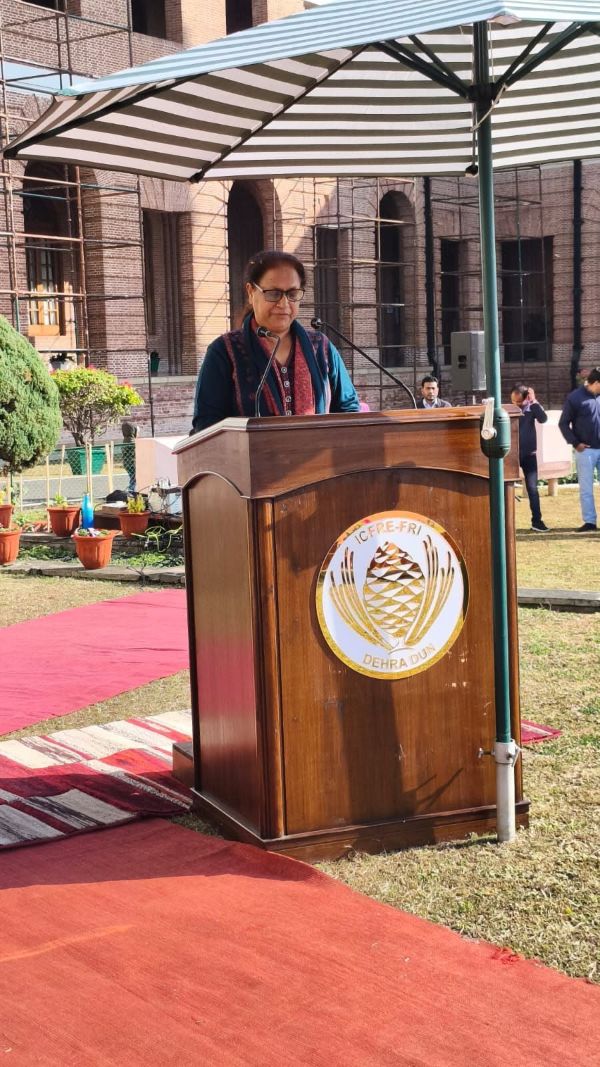
Kanchan Devi, Director General of the Indian Council of Forestry Research and Education (ICFRE), on Wednesday stressed that Green Credits must reflect measurable ecological restoration on the ground rather than being treated merely as financial assets or certificates.
Her message underlined the need to assess the actual environmental benefits of activities undertaken under the Green Credit Programme. For instance, in tree plantation projects, success should not be measured only by the number of saplings planted but also by their survival and contribution to ecological restoration. Similarly, water management and mangrove restoration projects should deliver verifiable environmental benefits.
Devi was speaking as the chief guest at a workshop organised by ICFRE at the Forest Research Institute’s Convocation Hall in Dehradun to encourage wider stakeholder participation and accelerate implementation of the Green Credit Programme (GCP).
The workshop brought together more than 70 participants representing around 35 public sector undertakings and corporate entities, along with officials from ministries and regulatory bodies.
R. Raghu Prasad, Inspector General of Forests (Forest Policy) in the Union Ministry of Environment, Forest and Climate Change (MoEFCC), highlighted the importance of expanding stakeholder participation to accelerate the programme’s implementation.
The Green Credit Programme was proposed by Prime Minister Narendra Modi at the G20 Summit in September 2023. Its rules were notified on October 12, 2023, under the Environment (Protection) Act, 1986, with ICFRE serving as the programme administrator. The Global Green Credit Initiative portal was jointly launched by Modi and the UAE President during the COP28 climate conference in December 2023.
The programme covers eight activities: tree plantation, water management, sustainable agriculture, waste management, mangrove restoration, Ecomark labels, sustainable building and infrastructure, and measures to reduce air pollution.
Initially, the tree plantation and ecological restoration component focused on public sector undertakings. These efforts covered around 4,391 hectares across 12 states, according to information shared at the workshop.
The programme’s methodology was revised in August 2025 and its implementation modalities in September 2025 to broaden participation. Private companies, corporate entities, non-governmental organisations, philanthropic institutions, individuals and other eligible entities can now participate under the revised framework.
Technical sessions at the workshop covered the programme’s regulatory framework, afforestation on degraded forest land to meet compensatory afforestation requirements, and environmental, social and governance (ESG) disclosures.
The workshop was attended by Arti Chaudhary, Director of International Cooperation at ICFRE; Amit Anand, Deputy Inspector General of Forests (Forest Policy) at MoEFCC; and Mahaling, head of ICFRE’s Green Credit Cell, among other officials.