
 By Shishir Prashant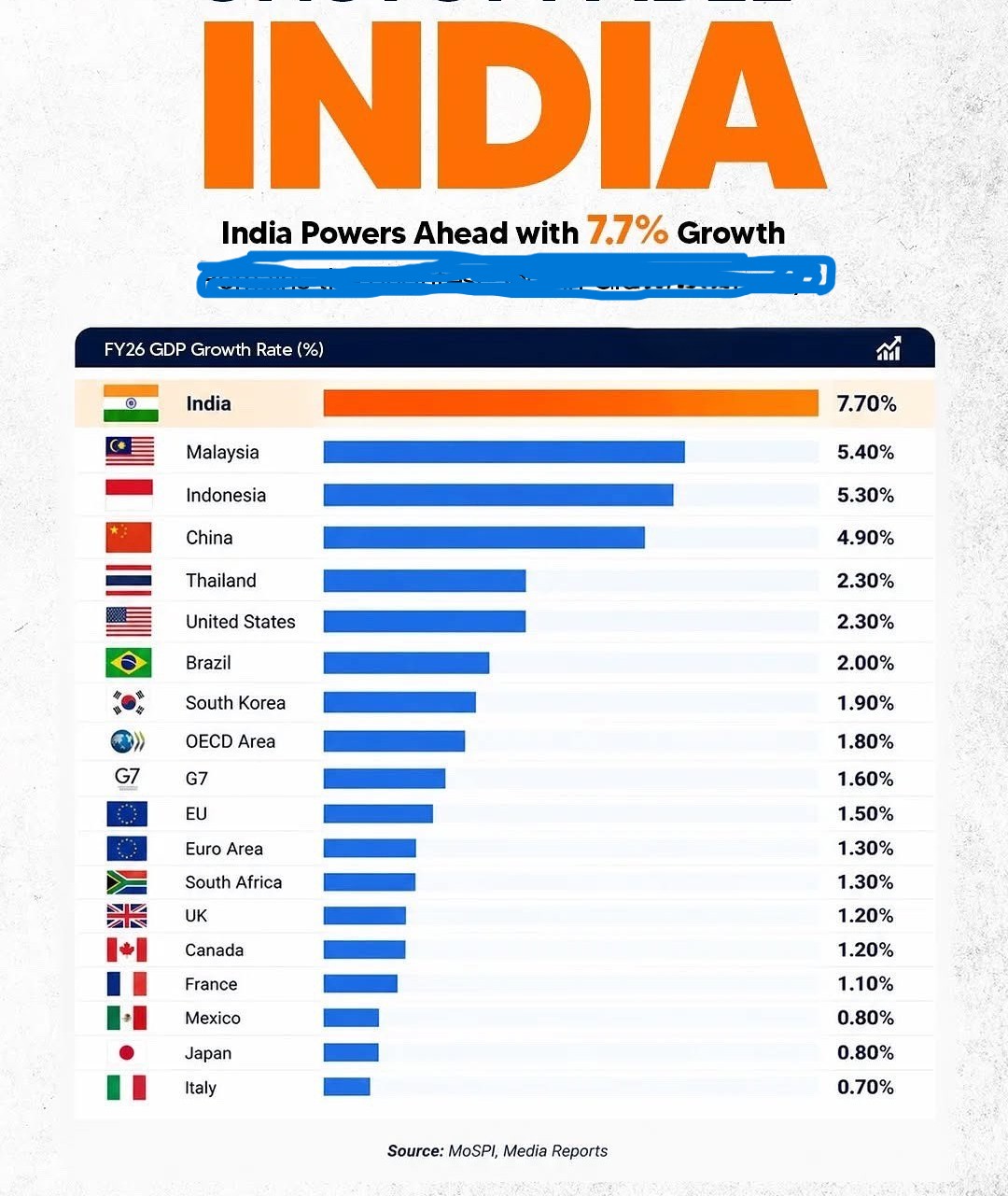
PrashantNews
With the Iran conflict impacting global economy, India’s robust economic growth of 7.7 percent during the financial year 2025-26 has left many economists perplexed.
Significantly, PM Narendra Modi had also recently appealed to the people in India to help conserve foreign exchange reserves amid rising crude oil prices and economic uncertainty linked to the Iran conflict.
The new GDP numbers are certainly surprising. In recent years strong doubts have been raised about the methodology of calculating GDP and the assumptions underlying its estimation especially related to the informal sector. But that does not mean that the numbers are manipulated.
In the post demonetisation, GST and COVID lockdowns scenario, economists believe the informal sector has contracted sharply. There are no reliable statistics about its volume and the growth data of the informal sector. It is generally believed that the formal sector data is mechanically applied to the informal sector as well.
In the past few years, the unemployment and low per capital income in India has also remained a major concern. Top economists said the GDP data hides the structural weaknesses of the economy which is being driven primarily by investments in infrastructure. Private sector is still shy of showing its animal spirit for capex, they said.
Nevertheless, official data released by the Ministry of Statistics and Programme Implementation (MoSPI) showed that the economy grew faster than the previous year’s revised growth rate of 7.1 per cent and exceeded earlier estimates.
At a time when many advanced and emerging economies are grappling with slowing growth, high inflation and geopolitical tensions, India has managed to sustain strong momentum driven by domestic demand and services-sector expansion.
Economic data showed that manufacturing, trade, transport, financial services and construction emerged as major growth drivers. Gross Fixed Capital Formation (investment) and Private Final Consumption Expenditure also recorded healthy growth, indicating rising business confidence and consumer spending.
The fourth quarter growth of 7.8 per cent was particularly noteworthy as it came despite global uncertainties, including disruptions in energy markets and geopolitical tensions in the Middle East.
A higher growth rate has several implications. It boosts government revenues, creates employment opportunities, attracts foreign investment and strengthens India’s case as a preferred global manufacturing and investment destination. Sustained growth also helps the government fund infrastructure projects and social welfare programmes without significantly straining public finances.
However, experts caution that maintaining this pace may not be easy. Rising crude oil prices, global trade disruptions, inflationary pressures and uncertain international economic conditions could weigh on growth in the coming months. Several analysts expect growth to moderate in FY 2026-27, underscoring the need for continued reforms and stronger private-sector investment.