
 By Shishir Prashant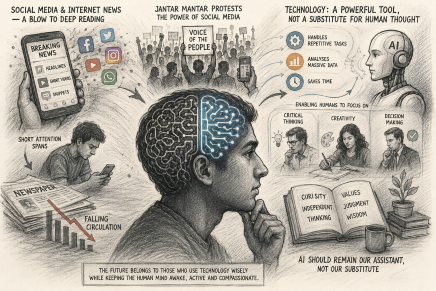
PrashantNews
The rapid rise of social media and internet-driven news has dealt a severe blow to newspaper circulation and, more importantly, to the habit of deep reading. Today, a large number of people consume headlines, short videos and snippets of information instead of reading detailed reports or books. As attention spans shrink, the culture of thoughtful reading and critical reflection is gradually giving way to fast, fragmented consumption of information.
These developments are now well established.
Yet, the digital revolution has also demonstrated an extraordinary ability to bring people together for collective action. The Jantar Mantar protests, for instance, were a vivid reflection of the social media revolution that has transformed the world over the past two to three decades. They showed how digital platforms can mobilise public opinion, unite people around a common cause, and amplify voices that might otherwise have remained unheard.
This brings us to a larger question: Are digital technologies merely changing the way we work, or are they gradually changing the way we think? The answer is more nuanced than it appears.
There is considerable truth in the observation that after the advent of computers, the internet and now artificial intelligence, humans increasingly rely on machines for tasks that were once performed by their own minds. These technologies have transformed the way we think and work. They have become powerful extensions of human intelligence. The concern arises only when they begin to replace thinking instead of supporting it.
Before the digital age, people relied heavily on memory, mental arithmetic, libraries and personal reasoning. Today, we instinctively search the internet for information, use GPS instead of remembering routes, depend on calculators for simple calculations, and increasingly ask AI to write emails, solve problems, summarise books or even generate ideas. This has undoubtedly reduced the need to perform many mental tasks ourselves.
However, technology itself is not the problem. The real issue is how we choose to use it. Just as the invention of the microscope did not diminish a scientist’s intelligence but greatly enhanced scientific discovery, artificial intelligence can amplify human creativity and productivity when used wisely. It can perform repetitive tasks, analyse enormous amounts of data and save valuable time, allowing people to focus on innovation, critical thinking and decision-making.
The real danger lies in becoming intellectually passive. If students use AI to complete assignments without understanding the subject, or professionals stop questioning AI-generated answers, human reasoning and creativity may gradually weaken. AI can produce remarkably convincing responses, but it does not possess human judgment, moral values, emotions or lived experience. It can make mistakes, reflect biases in its training data, and sometimes present inaccurate information with great confidence. That is why human oversight remains indispensable.
History reminds us that every major technological revolution—from the printing press to the internet—has changed the way people communicate, learn and work. Artificial intelligence is no different, except that its impact is unfolding at a much faster pace and on a much larger scale. The challenge before society is not to resist technology but to ensure that it complements, rather than replaces, human intelligence.
The greatest strength of the future will not belong to those who depend entirely on AI, nor to those who reject it altogether. It will belong to people who embrace AI as a powerful tool while continuing to cultivate curiosity, independent thinking, creativity and sound judgment. Technology can process information at astonishing speed, but only the human mind can question it, interpret it, assign it values and ultimately use it wisely. Artificial intelligence should remain our assistant—not our substitute.