
 By Shishir Prashant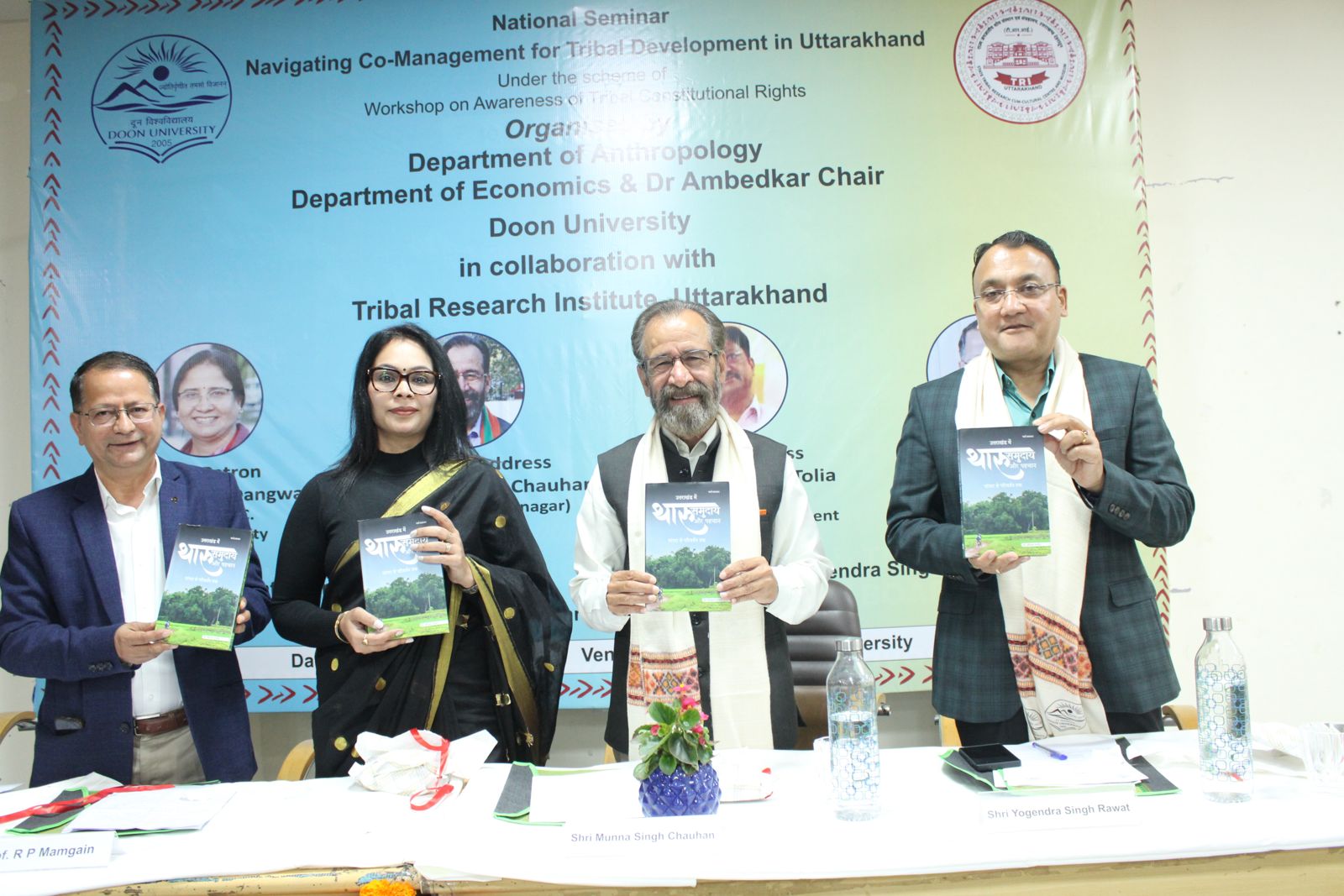
PrashantNews
A National Seminar on “Navigating Co-Management: Government Policies, Indigenous Practices, and Sustainable Development” was organised at Doon University on Friday bringing together academicians, policymakers, administrators, tribal representatives, civil society members, and research scholars, calling for sustainable approaches and a fundamental shift tribal development policy in Uttarakhand.
Jointly organised by the Department of Anthropology, Department of Economics, and the Dr Ambedkar Chair in collaboration with Tribal Research Centre, the seminar focused on evolving participatory models that integrate ecological sustainability, livelihood security, and cultural continuity while shifting the focus from welfare delivery to participatory co-management.
Delivering the inaugural address, Munna Singh Chauhan, BJP MLA from Vikas Nagar, emphasised the need for a comprehensive development strategy tailored to Himalayan realities. He stated that development interventions in tribal regions must combine livelihoods, ecology, culture, and indigenous knowledge systems rather than relying on fragmented welfare measures. He observed that several modern development approaches, including community resource management and collective land practices, have long existed within tribal societies and should serve as guidelines for contemporary policymaking. Stressing inclusive governance, he noted that sustainable outcomes would only emerge when communities become active partners in development planning and implementation.
Presiding over the inaugural session that brought together over 200 participants from across Uttarakhand and beyond, Doon University Vice Chancellor Prof. Surekha Dangwal, referred to recent consultations on the Uniform Civil Code (UCC) have brought into sharp focus the contrast between urban policy discourse and the lived realities of tribal communities. The consultations revealed that tribal communities are deeply anchored in tradition while actively engaging with questions of development and governance. Participants displayed that tribal societies are not passive recipients of policy but active contributors whose traditional knowledge systems and sustainable practices offer valuable pathways toward inclusive and environmentally balanced development. A strong sense of cultural pride emerged during discussions, with many community members expressing a preference for remaining in their ancestral regions, underscoring the importance of localized and culturally sensitive development approaches. Women participants played a particularly significant role, offering thoughtful and impactful suggestions that enriched the deliberative process, she said.
Welcoming the participants, Prof. R. P. Mamgain, Dean of the School of Social Sciences, elaborated on the main theme and sub-themes of the seminar while highlighting co-management as a pathway toward inclusive and sustainable development. He emphasised the importance of a bottom-up approach to development, underscoring the critical role of local institutions such as Van Panchayats in participatory governance and natural resource management. He also stressed the need for continued dialogue among policymakers, academic institutions, and tribal communities to shape future development trajectories in the Himalayan region.
In his special address, Mr Yogendra Singh Rawat, additional director of Tribal Research Institute, highlighted the self-sustaining nature of tribal societies and stressed the need to preserve tribal culture. He referred to initiatives such as PM-JANMAN aimed at ensuring full welfare coverage for PVTGs, particularly the Raji and Buksa communities, and emphasised effective implementation of the Forest Rights Act, 2006.
Renowned anthropologist, historian and cultural activist, Dr Lokesh Ohri spoke of the threats to the culture of the Jad Bhutia, transhumant community of the Harsil Valley near Gangotri. His talk focused on the Lal Devta or Meparang of the Jads. He mentioned the India-China conflict leading to closure of trade and the new opportunities arising out of Vibrant India scheme.
The lead speakers of different sessions included Prof Dev Nathan, Professor M S Panwar, Professor Bina Saklani, Prof Vijoy S Sahay, Dr K R Nautiyal, Prof H C Purohit, Prof Anjali Chauhan, Prof Ritesh Chaturvedi, among others. A book on Tharu tribe authored by Dr Saumyata Pandey was also released on the occasion.
The seminar featured multiple technical sessions examining different dimensions of tribal development. The first technical session focused on changing livelihood patterns among tribal communities such as the Bhotia, Tharu, Buxa, Jaunsari, and Raji. Speakers discussed how historical livelihoods rooted in forests, alpine pastures, wetlands, and cross-border trade networks have undergone significant transformation due to environmental changes, market pressures, and policy constraints. Participants highlighted the decline of transhumant pastoralism following the closure of Indo-Tibet trade routes and increasing grazing restrictions, alongside challenges faced by Terai-based communities including land fragmentation, rising agricultural costs, and growing market volatility. Experts emphasised that policy responses must move beyond income-centric schemes toward strengthening livelihood resilience through institutional reforms, enterprise development, and locally contextualised planning.
The second session examined the role of indigenous knowledge systems in addressing climate change and ecological vulnerability in Himalayan regions. Speakers stressed that traditional ecological knowledge should not be treated as symbolic heritage but integrated meaningfully into governance frameworks through ethical engagement, community consent, and institutional recognition. Discussions underscored how community-based resource management practices can contribute to climate adaptation, biodiversity conservation, and sustainable natural resource use.
A third session explored the cultural and educational dimensions of tribal development. Participants expressed concern over the weakening inter-generational transmission of tribal languages and customary practices due to migration, urban exposure, and formal education structures. Scholars and practitioners suggested educational reforms, youth engagement programmes, and community-led documentation initiatives to ensure that development does not result in cultural erosion. The session highlighted the importance of culturally sensitive policy frameworks that promote both modern opportunities and identity preservation.
In his concluding remarks during valedictory session, Dr Ambedkar Chair Professor Harsh Dobhal summarised the proceedings of the day and emphasised upon the importance of participatory governance and institutional accountability. He noted that co-management represents a practical framework of shared responsibility between state institutions and local communities in managing forests, land, and water resources. Strengthening Gram Sabhas and revitalising local governance institutions, he said, would be essential to bridge gaps between policy intent and implementation on the ground.
Central to the seminar discussions was the idea of co-management, emphasizing shared governance between state institutions and tribal communities in managing land, forests, and water resources. Participants noted that despite progressive legal frameworks and decentralized governance mechanisms, significant gaps remain in implementation, including the weakening of Van Panchayats, uneven enforcement of forest rights, and continued reliance on top-down planning approaches. The seminar recommended strengthening Gram Sabhas, improving transparency in Tribal Sub-Plan allocations, promoting convergence among development and disaster mitigation programmes, and adopting district-specific planning aligned with local ecological and socio-economic realities.