
 By Shishir Prashant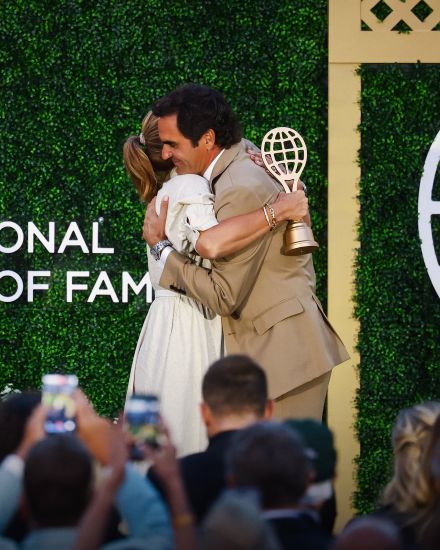
PrashantNews
Tennis great Roger Federer has spent much of his life teaching the world how to win with elegance. On Saturday night, at the International Tennis Hall of Fame in Newport, the 20-time Grand Slam champion showed something far more human — how difficult it can be to say goodbye to the life that made you.
Federer broke down several times during his induction speech. He paused, wiped away tears and even joked that he needed tissues and sunglasses to survive the evening. But interestingly, the tears were not for the defeats that once broke his dreams on the tennis court. They came while he spoke about the people and memories behind his extraordinary journey — his childhood, his heroes, his coaches and, most painfully, his wife Mirka.
And yet, somewhere beneath that emotional speech were two losses that will forever remain part of the Federer story: Wimbledon 2008 and London 2012. The first was perhaps the most painful.
Federer arrived at Wimbledon in 2008 as a five-time defending champion, one victory away from surpassing Björn Borg’s record of five consecutive Wimbledon titles. Then came Rafael Nadal.
What followed became one of the greatest matches tennis has ever witnessed. After 4 hours and 48 minutes, Nadal finally beat Federer 6-4, 6-4, 6-7, 6-7, 9-7, ending Federer’s five-year reign on Centre Court. Federer had fought back from two sets down, saved match points and pushed Nadal to the edge. But at 9-7 in the fifth, the dream was gone.
It was more than a defeat. It was the first great crack in the Federer empire. The Swiss had wanted six consecutive Wimbledon titles. Nadal wanted to conquer the kingdom.
Years later, Federer would describe that defeat as one of the matches he wished he could have changed. But time transformed the pain into something else: a defining chapter of perhaps the greatest rivalry tennis has ever known.
Then came London. Four years after Nadal had stopped him at Wimbledon, Federer returned to the same courts for the 2012 Olympics. This time the opponent was Andy Murray, playing in front of his home crowd. Federer had beaten Murray in the Wimbledon final only weeks earlier. Olympic gold, however, slipped away brutally quickly. Murray won 6-2, 6-1, 6-4, leaving Federer with the silver medal. It was a peculiar defeat because Federer had not merely lost a final. He had lost an opportunity to complete one of the few achievements missing from his résumé — an Olympic singles gold medal.
And perhaps that is why those two matches remain so compelling. Federer’s career is usually told through numbers: 20 Grand Slam titles, eight Wimbledon titles, six Australian Opens, five US Opens, one French Open, 103 ATP titles and 310 weeks as world No. 1.
But greatness is also defined by what never happened — the sixth Wimbledon crown in a row and the Olympic singles gold.
And perhaps Federer understood better than anyone that these absences did not diminish his career. They made it human. That humanity was on full display in Newport.
Federer spoke very little about his records. Instead, he remembered being a 13-year-old ball boy in Basel, standing at the back of the court and watching professional players from close range. He remembered his parents, his coaches and the heroes who inspired him. And when he reached Mirka, the composure that had served him for decades disappeared.
“Now the Mirka part,” he said, before pausing and breaking down. “Oh gosh, this is such a mess.” The man who had spent years controlling his emotions on the biggest tennis courts in the world could not control them anymore. There was something beautiful about that.
Federer did not cry because he had won 20 Grand Slams. He cried because he remembered why he played. He cried for the boy from Basel who once stood behind the court as a ball boy. He cried for the people who travelled the journey with him.
And perhaps, somewhere in the silence between those tears, were the ghosts of Wimbledon 2008 and London 2012 — the dreams that got away.