
 By Shishir Prashant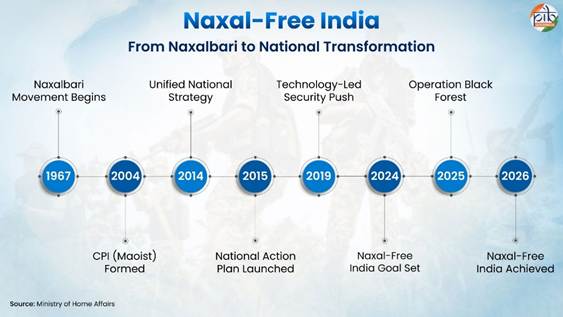
PrashantNews
The Centre has recently declared India effectively free from Left-Wing Extremism (LWE) called naxalism, marking March 31, 2026, as a historic milestone in the country’s internal security journey.
But the achievement came after a major policy shift to end nearly six decades of conflict.
In a detailed statement on Friday, the government said the achievement was the result of a comprehensive strategy built on three pillars — Vishwaas (trust), Nirman (development), and Jan Kalyan (welfare) — that combined security operations with infrastructure development and social inclusion.
Naxalism, which emerged from the Naxalbari uprising in West Bengal in 1967, had for decades posed one of India’s most serious internal security challenges. The decade between 2004 and 2014 was particularly violent, witnessing over 17,500 incidents, more than 5,000 civilian deaths, and nearly 2,000 security personnel fatalities.
The government said a major policy shift came in 2015 with the launch of the National Policy and Action Plan against LWE, replacing what it described as fragmented and reactive responses with a coordinated national strategy involving security, development and governance interventions.
According to official figures, Naxal-related incidents fell from 870 in 2014 to 234 in 2025, while fatalities declined from 310 to 100 during the same period. The number of LWE-affected districts dropped from 126 in 2014 to just two by 2026, with no district remaining in the “most affected” category. Police stations reporting Naxal incidents dropped from 333 to 16 during the past one decade.
The government highlighted the creation of a stronger security grid, including 597 fortified police stations, 408 new CAPF camps, advanced surveillance technology, drones and intelligence-driven operations. Several major anti-Naxal operations, including Operation Black Forest and Operation Double Bull, were credited with dismantling Maoist strongholds.
Alongside security measures, authorities expanded infrastructure and welfare programmes in affected regions. More than 12,000 km of roads were built, over 9,600 mobile towers installed, and thousands of banking outlets, schools and skill development centres established. Nearly 4,000 Maoist cadres surrendered between 2024 and March 2026 under rehabilitation schemes offering financial assistance, education and livelihood support.
The government cited Bastar in Chhattisgarh as a model of transformation, where improved security, road connectivity, tribal welfare programmes and local participation helped replace decades of insurgency with development.
Calling the achievement a defining chapter in independent India’s history, the government said the end of Naxal violence marks the beginning of a new era of peace, inclusion and economic progress for tribal and remote communities.