
 By Shishir Prashant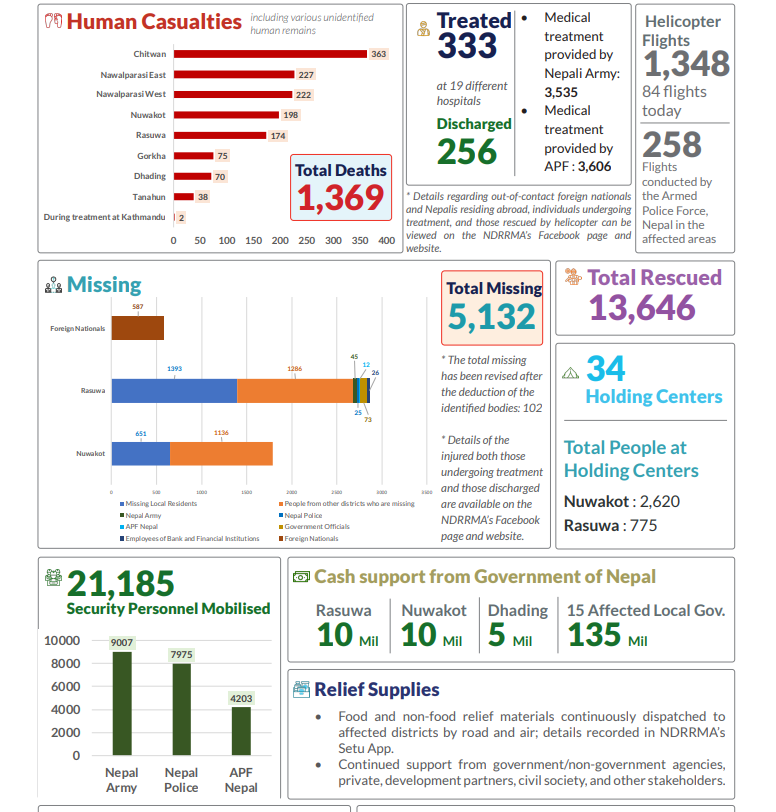
PrashantNews
The death toll from the devastating flash floods that swept through parts of Nepal following an ice-rock avalanche near the Nepal-Tibet border has risen to 1,377, while 5,130 people remain missing, according to the latest figures released by Nepal’s National Disaster Risk Reduction and Management Authority (NDRRMA).
The disaster, which struck on August 26, triggered massive floods along the Bhotekoshi River and other downstream waterways, destroying homes, roads and bridges and severely damaging hydropower projects across northern and central Nepal.
According to the latest NDRRMA figures, 364 bodies have been recovered from Chitwan, the highest number among the affected districts. Another 228 were recovered from Nawalparasi East, 222 from Nawalparasi West, 198 from Nuwakot, 178 from Rasuwa, 77 from Gorkha, 70 from Dhading and 38 from Tanahu. Two more victims died while undergoing treatment in Kathmandu.
Search and rescue operations are continuing across the affected areas, with 13,656 people rescued so far. Security personnel are conducting searches for thousands of people still unaccounted for, although the scale of destruction and difficult terrain are making the operation increasingly challenging.
The disaster has also caused extensive damage to Nepal’s hydropower infrastructure. More than a dozen hydropower projects were affected, while hundreds of workers were reported missing from project sites, including tunnels. International rescue teams from India, China, South Korea and the United States have been assisting Nepal in the search operations.
Nepal has meanwhile begun using drones to deliver food, medicines and other essential supplies to communities cut off by destroyed roads and bridges. The Nepal Army is operating four drones capable of carrying loads of up to 60 kg.
The catastrophe has also triggered a wider debate over floods plains encroachments, climate change, early-warning systems and environmental concerns related to hydropower projects in the Himalayan region. Nepal is seeking around $5 billion in international assistance for the initial phase of reconstruction and recovery.