
 By Shishir Prashant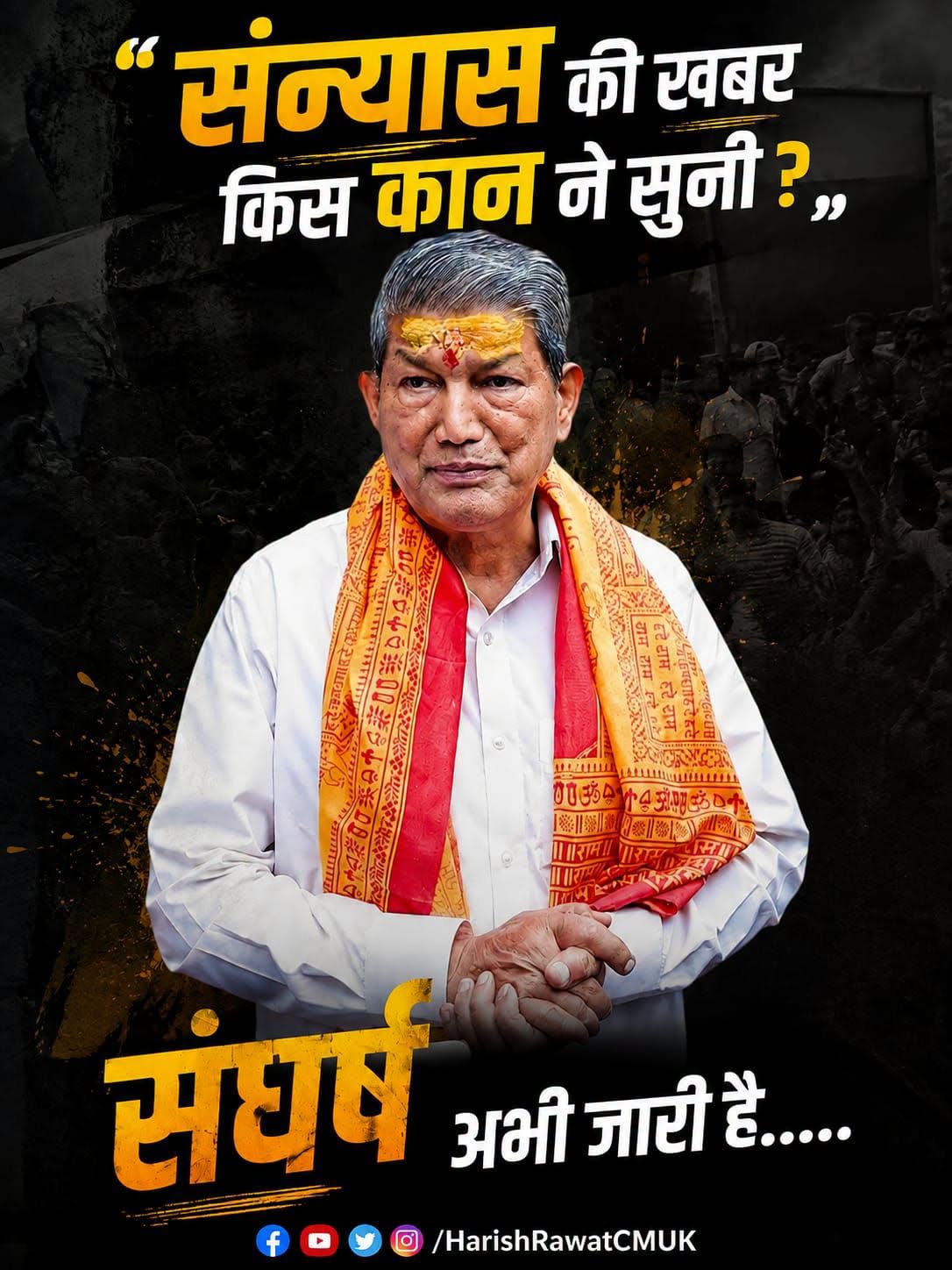
PrashantNews
Clearly suggesting that he is ready to take new responsibility, former Uttarakhand chief minister Harish Rawat has sounded a poll bugle in Congress circle ahead of the assembly elections in 2027 saying he is not going anywhere.
Political analysts say through the new social media post which is ostensibly to deny a political rumour, Rawat has tried to convey the message to the Congress organisation and rival factions in Uttarakhand that his position in the party should not be undermined in anyway.
Rawat has strongly rejected reports that he has announced his retirement from active politics, sarcastically asking where he made such an announcement. His unusual reference to “the ear” on which he supposedly announced his retirement underlines his contention that the claim is entirely fabricated.
The timing and tone of the post, however, suggest that Rawat is responding to more than an ordinary piece of political gossip.
Rawat says a story claiming that he has been “sidelined” or has decided to retire is being deliberately circulated and even taken to the national media. Without naming anyone, he accuses sections of his political opponents of spreading misinformation and attempting to create confusion within the Congress.
His message is particularly significant because Uttarakhand Congress has long been marked by competing political centres of influence, with Rawat remaining one of the party’s most recognisable leaders despite the changing equations within the state unit.
‘I am not going anywhere’. The most important political message in Rawat’s post is that he does not see himself as politically finished.
He points out that he is about to enter his 60th year as a Congress member, an unusually emphatic reminder of his long association with the party. By invoking this history, Rawat appears to be asserting that his political relevance cannot simply be determined by the current organisational arrangement or by rival leaders.
At the same time, Rawat acknowledges that his physical condition has restricted his ability to remain as active as he would like. He says that while his physical activities are currently limited, he is continuing to use his “brain” for the interests of Congress and Uttarakhand.
This is an important distinction. Rawat is effectively saying that reduced physical visibility should not be interpreted as political retirement.
His prolonged stay in Delhi for medical reasons may have created an opportunity for rivals to speculate about his political future. Rawat appears determined to prevent that speculation from becoming an established political narrative.
Rawat says his political life has always been an “open book” and that he does not operate through whispers. If he ever decides to take a major political step, he says, he would consult people, inform them and make the announcement publicly and ceremonially.
This is perhaps the clearest part of his rebuttal.
In political terms, Rawat is establishing a communication protocol around his own political future: if there is an important announcement from him, it will come directly from him—not through anonymous sources, political gossip or social media speculation.
His repeated emphasis on openness is also a subtle contrast with what he describes as the politics of “whispers, propaganda and making people fight”.
Why the rumour matters
The controversy is significant because a rumour about Rawat’s retirement has consequences beyond Rawat himself.
Any perception that one of Congress’s most experienced leaders is withdrawing from politics could trigger speculation about succession, leadership space and factional balance within the Uttarakhand Congress.
For rivals, the idea of Rawat becoming politically inactive could potentially alter the internal equation. For Rawat, therefore, silence could be politically costly.
His decision to publicly and forcefully reject the retirement narrative indicates that he does not want his temporary physical absence or reduced political activity to be interpreted as an exit.
There is also a larger electoral context. With Uttarakhand heading towards the 2027 Assembly elections, questions over the Congress leadership and the roles of its senior leaders are inevitably gaining importance. In such an environment, rumours about the political future of a former chief minister can acquire a significance far beyond their factual basis.
The bigger Rawat message
Rawat’s post therefore serves two purposes. First, it is a personal clarification: he has not announced retirement. Second, and more importantly, it is a political assertion: his political voice remains relevant and he intends to remain engaged with Congress and Uttarakhand.